

Online marketing strategies: complete guide
Most businesses don't struggle with online marketing because they lack options. They struggle because every channel starts to look urgent.
SEO promises compounding traffic. Paid search promises fast leads. Social media promises reach. Email promises retention. Video promises attention. Influencer and affiliate marketing promise borrowed trust. AI promises speed across all of it.
The hard part isn't knowing these channels exist. The hard part is deciding which ones deserve budget, what job each channel should do, and how to stop your marketing from becoming a pile of disconnected tactics.
Online marketing works when every channel has a role. Some channels create demand. Some capture demand. Some build trust. Some convert buyers who are already close. Some bring customers back after the first sale. When those roles are clear, your marketing becomes easier to measure and easier to improve.
This page gives you a practical framework for building an online marketing strategy, comparing major digital channels, and choosing the right mix for your business. It also connects to deeper Tech Help Canada resources where a topic deserves its own page, so this can work as the hub instead of trying to repeat every detail in one place.
SEO, paid search, content, email, social, video, influencers, and affiliates each play a different role.
Market, message, media, and measurement keep the channel mix from becoming random activity.
Fund what works, test promising opportunities, and reserve room for experiments.
The best online marketing strategies make channels reinforce each other instead of competing for attention.
Explore the online marketing strategy guide
Jump to the framework, channel comparison, ROI guidance, budget planning, strategy examples, FAQ, or references.
- What is online marketing?
- Online marketing strategy vs. online marketing tactics
- The digital marketing strategy framework
- The main online marketing channels
- How AI is changing online marketing
- Online marketing ROI comparison
- Digital media strategy, brand strategy, and sales strategy
- The marketing mix in digital marketing
- How to choose the right channels
- Online marketing strategy examples
- How to build an online marketing strategy
- How online marketing channels work together
- Digital marketing communication: make every channel say the same thing
- The biggest online marketing mistakes
- A simple online marketing plan you can use
- Making online marketing work
- FAQ
- Related
- References
Contents
What is online marketing? #
Online marketing is the use of internet-based channels to attract, engage, convert, and retain customers. It includes search engine optimization, paid search, content marketing, email marketing, social media, video, influencer partnerships, affiliate programs, and the website experiences that turn attention into revenue.
People often use "online marketing," "internet marketing," "digital marketing," and "virtual marketing" as if they mean the same thing. In everyday business use, that's usually fine. A stricter definition would say digital marketing is broader because it can include offline digital channels, such as digital signage or some SMS campaigns. Online marketing is narrower because it focuses on internet-based activity.
For most small businesses, the practical question is simpler: how do people find you online, what do they see when they get there, and what makes them take the next step?
Online marketing strategy vs. online marketing tactics #
An online marketing tactic is an action. Posting a Reel, running a Google ad, publishing a blog post, sending a newsletter, testing a landing page, or launching an affiliate offer are all tactics.
An online marketing strategy decides why those tactics exist. It should answer six questions before any channel gets serious investment:
| Strategy question | What it decides |
|---|---|
| Who are we trying to reach? | Audience, buyer stage, market segment, and decision-maker |
| What do they need to believe before they buy? | Core message, proof, objections, and content themes |
| Where do they already search, scroll, compare, or ask for advice? | Channel selection and digital media strategy |
| What action do we want next? | Lead capture, booking, purchase, trial, quote request, or repeat visit |
| What does that action need to be worth? | Budget, cost per acquisition, and ROI expectations |
| How will we know it's working? | KPIs, attribution model, reporting cadence, and review process |
Without strategy, channels fight each other. SEO targets one message. Ads target another. Social media chases whatever is trending. Email follows up with something unrelated. The customer feels the disconnection even if they can't name it. With strategy, each channel reinforces the same business goal from a different angle.
The digital marketing strategy framework #
A strong digital marketing strategy framework has four layers: market, message, media, and measurement.
The market layer defines who you're trying to reach and what kind of demand already exists. Some audiences are actively searching for solutions. Others don't know they have a problem yet. You don't market to those two groups the same way.
The message layer defines what you want people to remember. This is where your offer, positioning, proof, and brand point of view come together. A weak message makes every channel more expensive because ads need more impressions, content needs more traffic, and sales conversations need more convincing.
The media layer defines where the message should appear. This is your digital media strategy. It includes owned channels, such as your website and email list; earned channels, such as organic search, press, shares, and referrals; and paid channels, such as search ads, social ads, sponsorships, and creator partnerships.
The measurement layer defines what counts as progress. Traffic alone isn't enough. Engagement alone isn't enough. You need leading indicators that show momentum and business metrics that prove the work is turning into revenue.
Here is the simplest way to use the framework:
| Layer | Core decision | Example output |
|---|---|---|
| Market | Who are we trying to reach and what stage are they in? | Local service buyers comparing providers, ecommerce shoppers searching product alternatives, or B2B buyers researching a risk |
| Message | What should they understand, believe, or feel? | A clear promise, proof points, objections, and brand tone |
| Media | Where should the message show up? | SEO, paid search, LinkedIn, TikTok, email, YouTube, creators, affiliates, or partnerships |
| Measurement | What proves this is working? | Qualified leads, sales, CAC, ROAS, conversion rate, repeat purchases, or pipeline contribution |
This framework keeps your online marketing plan from becoming a channel checklist. It forces every channel to earn its place.
The main online marketing channels #
Search engine optimization (SEO) #
Search engine optimization is the work of making your website easier for search engines, AI systems, and customers to understand. It includes technical SEO, keyword research, on-page optimization, content structure, internal linking, authority building, and conversion-focused page improvements.
Organic search remains one of the strongest discovery channels because people use search when they have intent. They may be trying to solve a problem, compare options, learn a topic, or find a provider. That intent gives SEO a different job from social media. Social media often interrupts the feed. Search meets demand that already exists.
BrightEdge's channel share research has long shown organic search as the dominant source of trackable web traffic, with organic channel share reported at 53.3%. Backlinko's 2025 CTR study also shows why ranking position matters so much: the first organic result averaged 27.6% CTR, while the top three results captured 54.4% of clicks.
AI search has made that top-position pressure even stronger. Pew Research Center found that Google users clicked a traditional result in 8% of visits when an AI summary appeared, compared with 15% of visits without one. Users clicked links inside AI summaries in only 1% of those visits. Our AI Search Benchmark Report covers the shift in more depth.
That doesn't make SEO less useful. It makes weak SEO less forgiving. Pages now need to be easier to cite, easier to skim, and more useful than thin answers. Strong SEO also has to extend beyond Google. People discover brands through YouTube, TikTok, Reddit, LinkedIn, newsletters, podcasts, AI assistants, and niche communities. That's why search everywhere optimization is becoming part of the strategy.
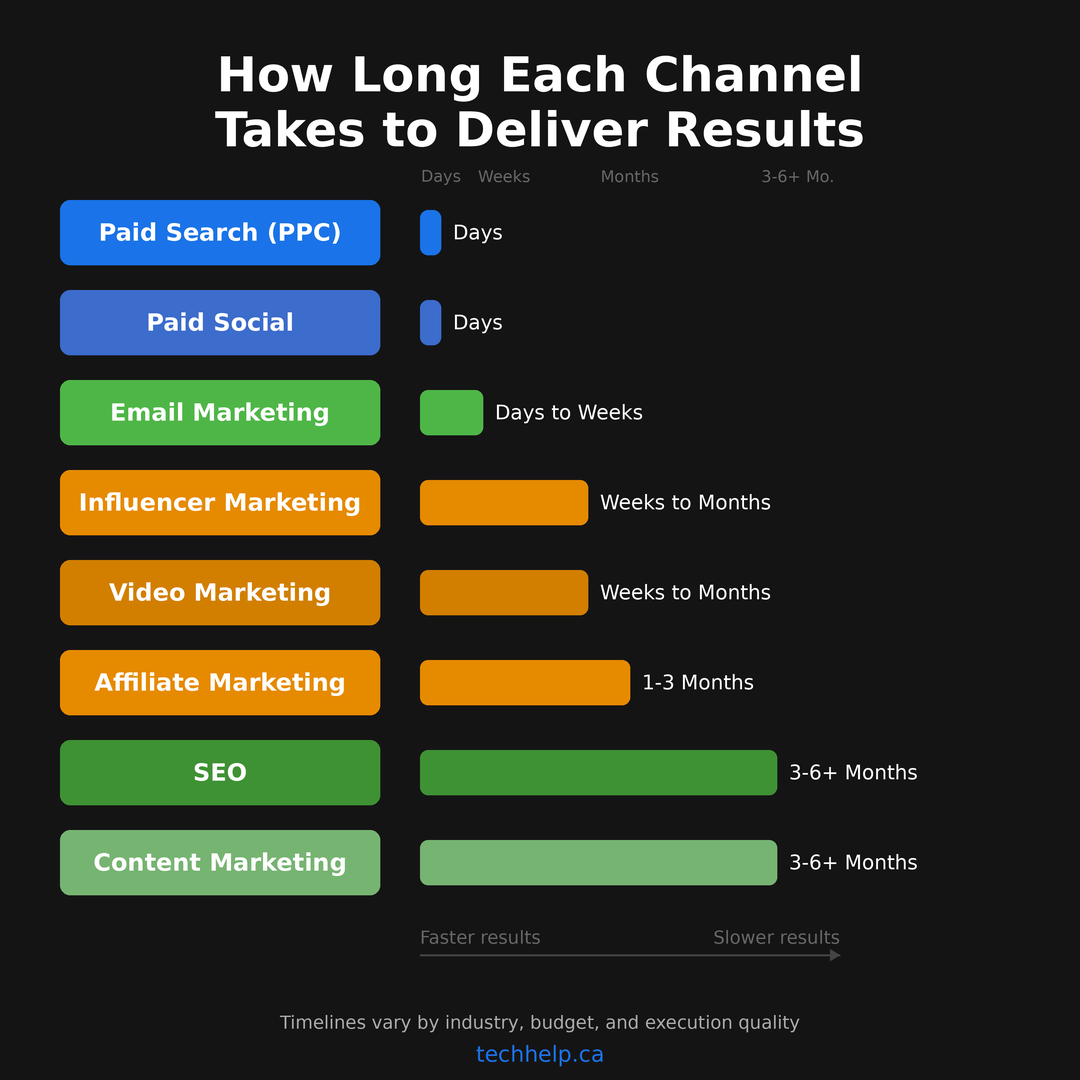
SEO is a long-term channel. It usually takes months to see meaningful gains, especially on competitive terms. But once a page ranks and converts, it can keep producing value without paying for every visit. That makes SEO one of the strongest foundations for businesses that can invest patiently.
Paid search (PPC) #
Paid search lets you buy visibility for the queries that matter most. Instead of waiting for rankings to build, you can appear in front of high-intent buyers as soon as a campaign goes live.
PPC is useful when speed matters. It can help test a new offer, validate keyword demand, support a product launch, fill the pipeline while SEO ramps up, or defend branded searches from competitors. It also gives you clean feedback on messaging because you can see which search terms, headlines, landing pages, and offers produce action.
The risk is that paid search can hide a weak funnel. A campaign can get clicks and still lose money if the landing page doesn't match the searcher's intent, the offer isn't clear, the form asks for too much, or the follow-up is slow. That's why conversion rate optimization belongs beside paid search, not after it.
Paid search is best treated as a testing and capture channel. Use it to capture existing demand, learn which messages convert, and support the pages you want to rank organically later. Don't use it as a substitute for building assets you own.
Content marketing #
Content marketing is the practice of publishing useful resources that attract, educate, and influence a specific audience. Blog posts, guides, videos, podcasts, research reports, templates, calculators, webinars, case studies, and newsletters can all be content marketing.
The channel works because it changes the relationship. Instead of asking for attention before you've earned it, you help the buyer understand the problem, compare options, avoid mistakes, or make a better decision. That usefulness builds trust before the sales conversation begins.
Content is also one of the few marketing assets that can support several channels at once. A strong guide can rank in search, feed an email sequence, support a paid retargeting campaign, give sales teams a follow-up resource, and become short-form social clips or graphics. Good content doesn't just publish and disappear. It becomes infrastructure.
This is where many businesses underinvest. They publish scattered posts instead of building useful hubs around the questions their buyers already ask. A better approach is to build content pillars, then repurpose the strongest ideas across formats. Our guides to content marketing strategies, content pillars, and content repurposing go deeper into that system.
Content marketing is rarely the fastest channel. It is one of the best channels for building authority, earning links, supporting SEO, and giving every other part of your marketing something stronger to say.
Email marketing #
Email marketing is the owned channel most businesses don't build early enough. Social followers belong partly to the platform. Search traffic belongs partly to the search engine. Your email list is one of the few audience assets you can reach directly.
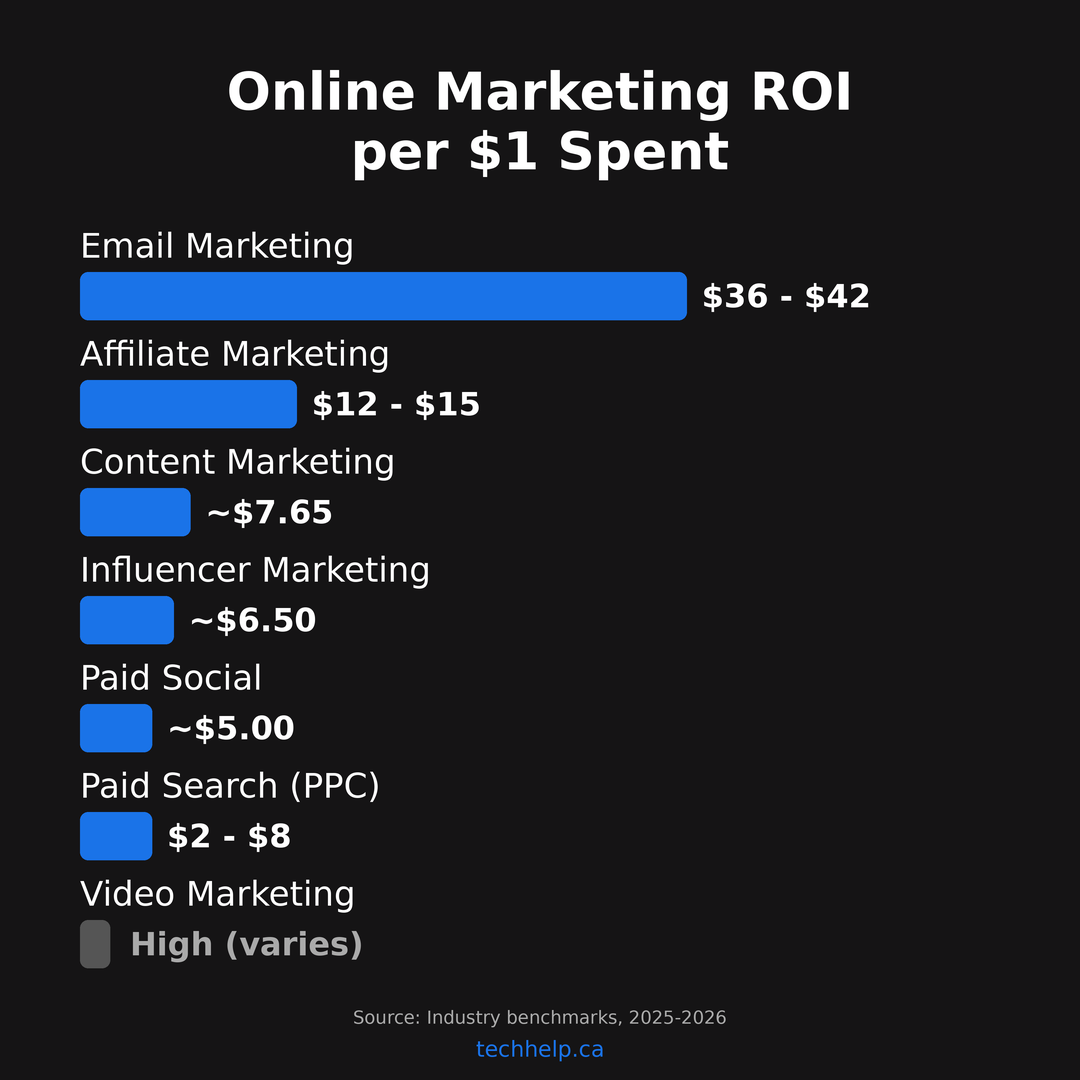
Email's ROI case is still strong. TechRadar's 2026 coverage cites Litmus benchmarks placing email return between $36 and $42 for every $1 spent, while also noting that performance varies sharply based on execution. Another TechRadar report covering Sinch Mailgun data found that many businesses still send campaigns without tracking ROI, but among those that do track it, 60% report more than $10 back for every $1 spent and more than 10% report returns as high as 40:1.
The difference usually comes down to segmentation, automation, and follow-up quality. A generic newsletter sent to everyone is not the same thing as a welcome sequence, abandoned cart sequence, post-purchase sequence, lead nurture flow, reactivation campaign, or behavior-based offer.
Open rates are also less reliable than they used to be because privacy features can inflate them. Click-through rate, conversion rate, revenue per email, reply rate, and list growth are usually more useful. Our email marketing and automation guide covers the channel in more detail.
Email works best when it connects the rest of your marketing. SEO and content bring people in. Social and video build familiarity. Paid campaigns create intent. Email turns that attention into an ongoing relationship instead of a one-time visit.
Social media marketing #
Social media marketing includes organic social, paid social, community participation, creator collaboration, and social listening. It can build awareness, distribute content, create trust signals, and keep your brand present between buying moments.
The mistake is treating every platform as interchangeable. Socialinsider's 2026 benchmark report shows how different the major platforms behave. TikTok's 2025 engagement rate was 3.70%, while Instagram was 0.48%, Facebook was 0.15%, and X was 0.12%. TikTok also stayed relatively strong in Q1 2026 at 3.40%, while Instagram fell to 0.45%.
Those numbers don't mean every brand should run to TikTok. They mean platform context matters. A B2B software company may get more business value from lower-volume LinkedIn conversations than from higher engagement on a consumer platform. A local business may still get meaningful results from Facebook Groups, local ads, and community posts even if broad page engagement is low.
Social media is strongest when it has a clear job. Use it to show proof, answer recurring questions, demonstrate expertise, share customer stories, test creative angles, and distribute useful content. Use paid social when you need controlled reach, retargeting, or creative testing at scale.
If your team is small, pick one or two platforms first. Build a repeatable cadence. Learn what people respond to. Expand only when the first channels are working. For a deeper channel-specific plan, see our guide on social media strategy.
Video marketing #
Video marketing gives people a faster way to understand what you do, how you think, and why they should trust you. It can work as education, proof, entertainment, product demonstration, sales enablement, or retargeting creative.
Wyzowl's 2026 video marketing report found that 91% of businesses use video as a marketing tool. The customer-side data is just as useful: 96% of people said they'd watched an explainer video to learn about a product or service, 85% said a video had convinced them to buy a product or service, and 84% wanted to see more videos from brands in 2026.
That doesn't mean every video needs to be expensive. For many businesses, the best starting point is clear, useful video: answering buyer questions, showing the product in use, explaining a process, comparing options, or walking through a common mistake. Good lighting and clear audio matter, but expensive production isn't the point.
Video also makes your marketing more efficient because one recording can become several assets. A webinar can become short clips, blog sections, email snippets, sales follow-up material, and social posts. A product demo can become a landing page asset, paid ad, help center video, and sales enablement resource.
If you're just getting started, our beginner's guide to video marketing covers the fundamentals.
Influencer marketing #
Influencer marketing is not just celebrity sponsorship. It is any structured partnership with a creator, expert, operator, publisher, community leader, or niche voice whose audience already trusts them.
The channel works because trust is hard to buy directly. A credible creator can introduce your product in a context that feels more natural than a brand ad. For B2B companies, that might mean a respected consultant, newsletter operator, analyst, or practitioner. For consumer brands, it might mean a product reviewer, educator, lifestyle creator, or niche community host.
Influencer Marketing Hub's 2026 benchmark report shows how performance-focused the channel has become. Among respondents who answered, 72.2% expected influencer budgets to increase by 50% or more, 65.9% expected payback within one month, and 66.3% reported running programs entirely in-house. TikTok was the most selected platform for investment intent at 31%.
The best influencer strategy starts with fit, not follower count. A smaller creator with a focused audience and strong trust can outperform a larger account with passive reach. The question isn't "How many followers do they have?" It's "Can this person credibly move the right audience closer to a decision?"
Influencer marketing also works better when the content has a second life. A creator post can become paid social creative, landing page proof, email content, product page material, or sales enablement. That reuse often makes the partnership more valuable than the original post alone.
Affiliate marketing #
Affiliate marketing is a performance-based channel where partners earn a commission when they drive a tracked sale, lead, or other defined action. The appeal is simple: you pay for outcomes instead of paying only for exposure.
Industry estimates put affiliate marketing at roughly $20.07 billion in value in 2026, with DemandSage reporting that affiliate marketing drives more than 16% of online orders in the United States and that more than 84% of brands have an affiliate program.
Affiliate marketing works best when three things are true: the product can be explained clearly, the conversion can be tracked reliably, and partners have a reason to promote it. Ecommerce, software, subscriptions, courses, digital products, and some service businesses can fit well. Complex offline sales with long buying cycles are harder unless tracking and partner terms are clear.
The channel also needs quality control. Not every affiliate is a good fit. Some will publish thin reviews, make exaggerated claims, bid on brand terms you didn't want them bidding on, or chase commissions without protecting the customer experience. A good affiliate program has clear rules, transparent commission terms, strong partner vetting, and regular performance review.
Affiliate marketing is strongest when it extends distribution you couldn't build alone. Review sites, niche publishers, creators, educators, and comparison resources can reach buyers at the exact moment they're deciding what to trust.
How AI is changing online marketing #
AI isn't an online marketing channel. It's a layer running across almost every channel.
HubSpot's 2026 State of Marketing Report found that 61% of marketers believe AI is causing marketing's biggest disruption in 20 years. The same report says 80% of marketers use AI for content creation and 75% use it for media production.
The useful question is not whether AI belongs in marketing. It already does. The useful question is where it improves the work without weakening judgment.
AI is strong at research assistance, first drafts, campaign variations, summarization, data analysis, audience segmentation ideas, email workflow mapping, ad concept testing, and turning one piece of content into multiple formats. It can help teams move faster and see patterns they might miss.
AI is weaker at original positioning, lived experience, customer empathy, brand taste, relationship building, ethical calls, and final accountability. If you outsource those things to automation, your marketing may get faster while becoming easier to ignore.
Use AI as support. Don't use it as a replacement for strategy.
Online marketing ROI comparison #
ROI comparisons are useful, but they can also be misleading. A channel with a high average return may still be wrong for you if you don't have the required audience, offer, tracking, or follow-up system.
Email is a good example. It often shows the strongest measured return because the cost of sending campaigns is low, but it only works if you have a list and a reason for people to stay subscribed. SEO can become highly profitable over time, but only after you earn visibility. Paid search can create leads quickly, but the math falls apart if your landing page or sales process can't convert them.
Use the table below as a planning tool, not a promise.
Scroll sideways to view the full table.
| Channel | Typical role | Speed to feedback | Cost pattern | Metrics to watch |
|---|---|---|---|---|
| SEO | Capture existing demand and build durable discovery | Slow | Upfront content, technical, and authority investment | Organic conversions, rankings, qualified traffic, assisted conversions |
| Paid search | Capture high-intent demand quickly | Fast | Pay per click, with costs rising as competition rises | CPA, ROAS, conversion rate, search terms, landing page performance |
| Content marketing | Build trust, authority, and search assets | Slow to medium | Research, writing, editing, design, and distribution | Leads, backlinks, engaged visits, assisted conversions |
| Email marketing | Nurture, retain, and reactivate | Fast once list exists | Low marginal send cost, higher strategy and automation effort | Revenue per email, clicks, conversions, replies, unsubscribes |
| Social media | Create familiarity, proof, and distribution | Medium | Time, creative production, and sometimes ad spend | Engagement quality, profile actions, referral traffic, conversions |
| Video marketing | Explain, demonstrate, and build trust quickly | Medium | Production time, editing, repurposing, and distribution | Watch time, completion, leads, assisted conversions, sales influence |
| Influencer marketing | Borrow trust and reach from credible voices | Medium | Creator fees, product costs, commissions, and amplification | Sales, CPA, creator content reuse, audience quality |
| Affiliate marketing | Extend distribution through partners | Medium to slow | Commission-based, with program management costs | Incremental revenue, partner quality, fraud checks, refund rate |
 Expand
The strongest online marketing strategies combine fast feedback channels with compounding channels. Paid search and paid social can teach you which messages convert. SEO, content, email, and brand-building channels turn that learning into assets that keep working.
Not sure which online marketing channels fit your business?
Digital media strategy, brand strategy, and sales strategy #
Online marketing gets weaker when media, brand, and sales are planned separately.
A digital media strategy decides where the message appears. It covers channels, formats, spend, targeting, frequency, and distribution. This is where you decide whether the plan belongs in search, paid social, newsletters, YouTube, creator partnerships, affiliates, or community channels.
A digital brand strategy decides what people should remember and trust. It covers positioning, tone, proof, visual identity, customer promises, and the point of view that makes the brand recognizable.
A digital sales strategy decides how interest turns into revenue. It covers landing pages, offers, lead capture, demos, checkout flows, sales follow-up, retargeting, and customer onboarding.
When those three strategies are aligned, the customer path feels coherent. The ad matches the landing page. The landing page matches the email. The email matches the sales conversation. The sales conversation matches the product experience.
When they aren't aligned, the business pays for attention and loses it in the handoff.
The marketing mix in digital marketing #
The classic marketing mix still applies online, but each part shows up differently.
| Marketing mix element | Online version | Strategy question |
|---|---|---|
| Product | Offer, package, features, proof, onboarding, customer experience | Does the offer solve a problem people already care about? |
| Price | Pricing page, discounts, payment options, trials, bundles, guarantees | Does the value feel clear before someone has to ask? |
| Place | Website, search results, marketplaces, social platforms, email, app stores | Where does the buyer expect to find or compare this offer? |
| Promotion | SEO, ads, content, video, creators, affiliates, email, PR, communities | Which channels can create or capture demand profitably? |
| People | Founder, team, sales, service, creators, customers, community | Who builds trust before and after the sale? |
| Process | Lead capture, checkout, booking, onboarding, support, retention | Where does friction stop people from moving forward? |
| Proof | Reviews, case studies, testimonials, demos, data, examples | What evidence makes the promise believable? |
This is especially useful for small businesses because online marketing problems often look like channel problems when they're actually offer, pricing, process, or proof problems.
A paid ad can't fix unclear pricing. SEO can't fix a weak offer. Social media can't fix a confusing checkout. Email can't fix a product experience that disappoints after purchase.
How to choose the right channels #
The weakest online marketing strategy is trying to do everything at once. Teams that focus on a few channels and execute them well usually outperform teams that spread effort across every platform they can name.
Choose channels by looking at audience behavior, buying intent, economics, and team capacity.
Filter 1: Where is your audience? #
This sounds obvious, but it gets skipped constantly. If your customers are procurement managers at manufacturing companies, TikTok probably isn't your first channel. LinkedIn, search, trade publications, email, webinars, and partner channels may fit better. If you're selling direct-to-consumer fashion to 18-to-30-year-olds, Instagram, TikTok, creators, email, and paid social may deserve more attention.
Don't assume. Look at your analytics, survey your customers, and study where competitors are getting traction. The data will tell you where to focus.
Filter 2: What can you actually sustain? #
Every channel requires consistent effort to produce results. SEO takes months before you see meaningful traffic. Social media demands regular posting. Email requires ongoing list building and content creation. Video needs production time.
Be honest about your team's capacity and budget. It's far better to run two channels well than five channels halfway. A neglected channel doesn't just fail to produce results. It can damage trust when people land on an abandoned social profile or a blog that hasn't been updated in months.
Filter 3: What outcome matters most right now? #
Different channels serve different business moments. Paid search and paid social are better when you need fast feedback. SEO and content marketing are better when you're building long-term visibility. Email is strongest when you already have leads or customers to nurture. Social media, video, and influencer marketing are better when people need familiarity and proof before they search for you directly.
Match channel selection to your business objective, not to what's trending.
Filter 4: What can your economics support? #
A channel can work and still be wrong for your business if the numbers don't hold. If your average sale is $40 and your margin is thin, you can't afford the same customer acquisition cost as a company selling a $5,000 service. If your product has high lifetime value, you may be able to spend more upfront because repeat purchases or renewals carry the return.
Before scaling any paid channel, know your gross margin, customer lifetime value, acceptable cost per acquisition, sales conversion rate, and payback window. Without those numbers, profitable marketing becomes guesswork.
Filter 5: How much trust must be built before someone buys? #
Some purchases are simple. Others require education, proof, comparison, and reassurance.
A low-cost impulse product may convert from a strong ad and a clean landing page. A high-ticket service, B2B tool, or complex professional offer usually needs more trust-building. That may mean SEO pages, comparison content, case studies, webinars, email nurture, testimonials, consultation calls, or creator partnerships.
The more trust your buyer needs, the more your online marketing strategy should invest in education and proof before asking for the sale.
Stage-based recommendations #
New businesses often benefit from one fast-feedback channel, one owned audience channel, and one authority-building channel. That might mean paid search, email, and SEO. It might mean paid social, email, and short-form video. The exact mix depends on the market, but the principle stays the same: learn fast, capture attention you own, and start building assets.
Growth-stage businesses can layer in more durable systems. This is often where SEO, content marketing, email automation, retargeting, creator partnerships, and better analytics become more valuable because there is enough customer data to make smarter decisions.
Established businesses can run a fuller mix, but only if measurement and ownership are clear. More channels mean more coordination, more attribution complexity, and more chances for the message to drift.
Online marketing strategy examples #
Strategy gets easier when you can see how the channel mix changes by business type.
Local service business #
A local service business usually needs trust, proximity, and fast response. The best channel mix often starts with local SEO, Google Business Profile optimization, search ads for high-intent service keywords, reviews, landing pages, and simple email or SMS follow-up.
Content should answer the questions people ask before calling: pricing ranges, service areas, warning signs, maintenance tips, comparison guides, and what to expect during the job. Paid search can capture urgent demand while SEO builds visibility. Email can bring past customers back for seasonal work, reminders, and referrals.
Ecommerce brand #
An ecommerce brand usually needs product discovery, conversion, retention, and repeat purchase. Paid social, creator content, SEO, email automation, affiliate partnerships, and product page optimization often work together.
The channel mix should connect discovery to purchase. A creator video introduces the product. Paid social amplifies the best creative. A product page answers objections. Email follows up with abandoned carts, post-purchase education, replenishment reminders, and cross-sells. Affiliate and review content help buyers compare options before they buy.
B2B or professional services company #
A B2B or professional services company usually needs authority before action. Search, LinkedIn, thought leadership, case studies, webinars, email nurture, and sales enablement content tend to matter more than broad reach.
The strategy should help buyers understand the problem, trust the expertise, and justify the decision internally. That often means long-form content, comparison pages, clear service pages, case studies, founder-led or expert-led social content, and follow-up sequences that help leads move from interest to conversation.
How to build an online marketing strategy #
Choosing channels is one decision. Building a strategy that works requires a process.
Step 1: Define what success looks like #
"Get more traffic" is not a useful goal. "Increase qualified organic leads by 30% in six months" is useful because it defines the channel, the business result, and the timeline.
Specific goals let you measure what's working, cut what isn't, and make rational budget decisions. If you're unsure where to start, our guide to setting online marketing goals walks through the process.
Step 2: Understand your audience #
You need to know more than basic demographics. Where do customers spend time online? What do they search when they're looking for a solution like yours? What content do they engage with? What objections do they have before buying? Who else influences the decision?
The deeper your understanding of the audience, the better every other decision becomes.
Step 3: Audit what you already have #
Before building something new, take stock of what exists. You may already have channels producing results that could be improved with more focus. You may also have channels consuming time without producing returns.
Review website analytics, email list health, social engagement, content performance, paid campaigns, conversion paths, reviews, CRM data, and sales feedback. The audit tells you where to double down and where to stop spending energy.
Step 4: Choose channel roles #
Don't just choose channels. Assign jobs.
SEO may capture people searching for solutions. Paid search may capture buyers ready to compare providers. Content may build trust before someone books a call. Email may nurture leads who aren't ready yet. Video may explain the offer faster. Social may keep the brand familiar. Affiliates may reach comparison shoppers.
A channel without a job becomes noise.
Step 5: Allocate budget deliberately #
Marketing budgets vary by business model, growth stage, margin, and category. Gartner's 2024 CMO Spend Survey, reported by The Wall Street Journal, found marketing budgets at 7.7% of company revenue among surveyed large companies, down from pre-pandemic levels. Smaller and younger businesses may spend a higher percentage when they are still building awareness.
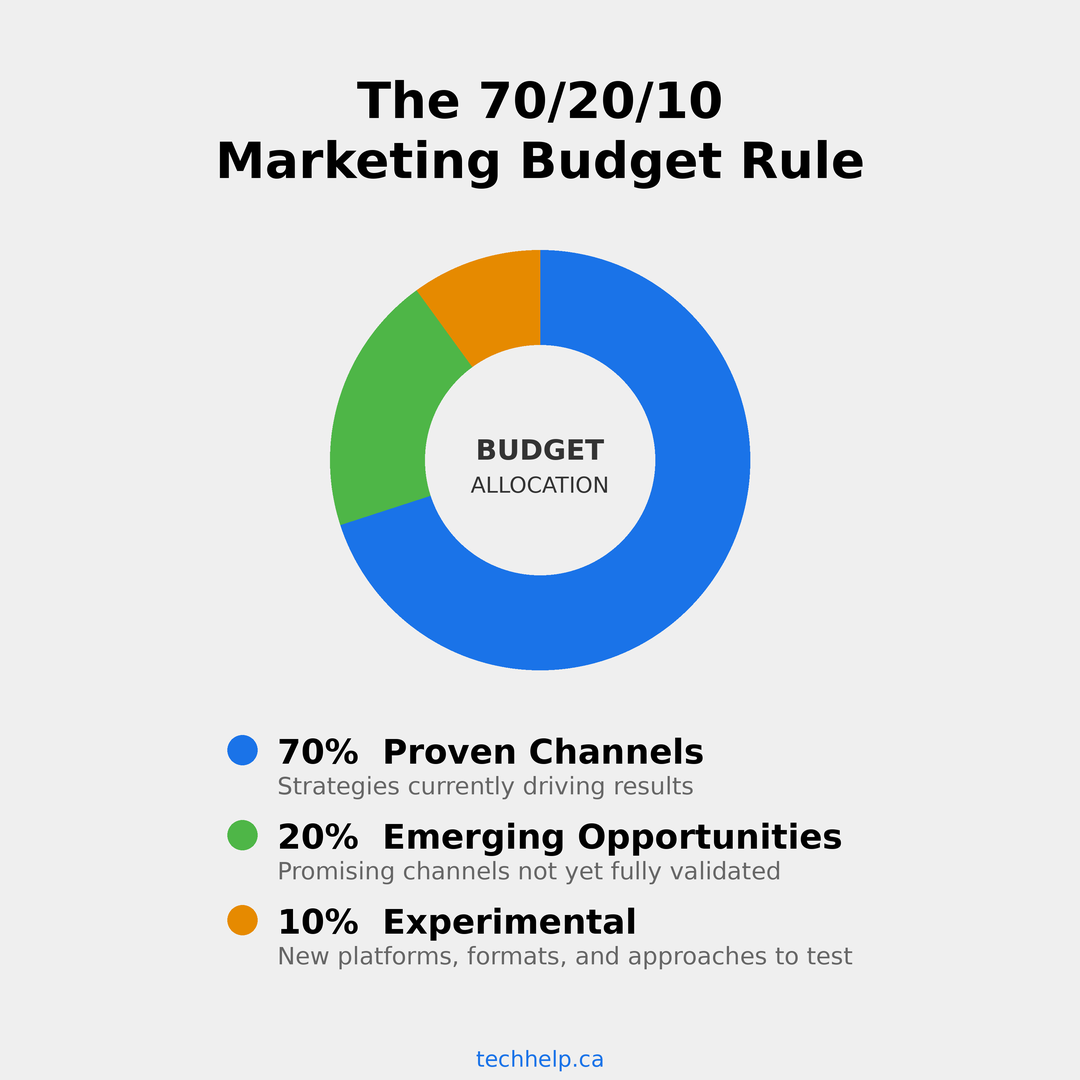
One useful planning model is the 70/20/10 rule. Put roughly 70% of budget into what already works, 20% into promising channels or creative tests, and 10% into experiments that may not pay off immediately but could open a new growth path.
 Expand
The rule isn't magic. It simply protects you from two common mistakes: overfunding experiments before the basics work, or clinging to old channels while the market changes around you.
Step 6: Build your measurement system #
Every channel should have metrics tied to its job. SEO should not be judged only by rankings. Social should not be judged only by likes. Email should not be judged only by opens. Paid ads should not be judged only by clicks.
Use leading indicators to see whether a channel is gaining momentum, then use business metrics to see whether that momentum is worth anything. For example, organic traffic is a leading indicator. Organic leads and revenue are business metrics. Video watch time is a leading indicator. Demo requests or assisted conversions from video viewers are closer to business impact.
Our guide to digital marketing metrics and KPIs can help you decide what to track.
Step 7: Improve the conversion path #
Traffic doesn't pay the bills. Conversion does.
Before scaling a channel, check the page or workflow it sends people to. Is the headline clear? Is the offer obvious? Does the page answer the right objections? Does it load quickly? Is the form too long? Is the call to action easy to find? Does the follow-up happen quickly?
Many businesses don't need more traffic first. They need more of the existing traffic to take action.
Step 8: Review, prune, and improve #
Marketing strategy is not a document you write once. It's a system you review.
Weekly reviews are useful for tactical checks, such as campaign pacing, broken tracking, ad performance, email engagement, and content production. Monthly reviews are useful for channel-level performance. Quarterly reviews are better for strategic decisions, such as shifting budget, adding a channel, pausing a channel, or changing the offer.
A strategy that never changes is usually not a strategy. It's a habit.
Need help turning this framework into a practical marketing plan?
How online marketing channels work together #
Running channels in isolation leaves money on the table. The goal is not to have more channels. The goal is to make each channel increase the value of the others.
SEO and content marketing are natural partners. Content gives you something to rank. SEO gives content visibility. Without SEO, useful content may never reach the right audience. Without content, there is little to optimize beyond service and product pages.
Email and content marketing create a compounding loop. Content attracts new visitors. Email captures people who want more. Then email delivers more content that moves them closer to a purchase. The content feeds the list. The list gives content another distribution channel.
Paid search and SEO cover different time horizons. PPC gives you immediate visibility while organic rankings build. SEO gives you durable visibility once authority improves. Paid search data can also reveal which keywords and messages deserve organic investment.
Social media and video help people feel familiar with the brand before they search or buy. Short-form content can create interest. Longer video can educate. Social proof can reduce hesitation. Retargeting can bring people back after they've already visited.
Influencer and affiliate marketing extend trust through third parties. A creator, publisher, or reviewer can reach audiences that may not respond to brand-owned content. If the partnership is credible, it can shorten the trust-building process.
Website UX and conversion optimization sit underneath everything. Every channel eventually sends people somewhere. If the page is confusing, slow, thin, or misaligned with the promise that got the click, the channel gets blamed even though the conversion path failed.
 Expand
Digital marketing communication: make every channel say the same thing #
Digital marketing communication is the discipline of keeping your message consistent across channels without making every channel sound identical.
A LinkedIn post should not read like a product page. A sales email should not read like a TikTok caption. A search landing page should not read like a newsletter. But the underlying promise should feel connected everywhere.
Use the same core message, the same proof, and the same customer understanding across channels. Adapt the format, pacing, and tone for the platform.
For example, a cybersecurity company might use the same campaign idea across several channels: small businesses are not too small to be targeted. SEO content could explain the risks. Paid search could target urgent queries. LinkedIn could share founder commentary. Email could deliver a practical checklist. A landing page could offer a security assessment. The formats change, but the message holds.
This is where a marketing communication plan becomes useful. It keeps the brand from sounding like a different company every time someone moves from one channel to another.
The biggest online marketing mistakes #
Most online marketing mistakes come from impatience, unclear ownership, or channel confusion.
One mistake is treating traffic as the goal. Traffic matters, but only if it brings the right people and moves them toward action. A smaller stream of qualified visitors can be worth more than a large stream of people who will never buy.
Another mistake is copying competitors without understanding their economics. A competitor may be able to spend more because their margin, retention, or average order value is stronger. Copying their ads or channels without knowing the business model behind them can burn budget quickly.
A third mistake is underfunding follow-up. Many businesses spend heavily to get a click, then do very little after the first visit. No email capture. No retargeting. No nurture. No sales enablement. No review request. No reactivation. The expensive part is often getting attention in the first place, so letting it disappear is wasteful.
A fourth mistake is publishing content with no distribution plan. Content without distribution is a quiet room. Before creating a major asset, decide how it will reach people through SEO, email, social, partners, communities, sales conversations, or paid amplification.
A fifth mistake is changing strategy too quickly. Paid channels can be evaluated faster, but SEO, content, brand, and community need time. Some teams quit right before the compounding starts because they expected every channel to behave like an ad campaign.
A simple online marketing plan you can use #
If you're starting from scratch, keep the first version simple.
Start with one clear audience and one main offer. Write down who you're trying to reach, what problem they have, what you want them to do next, and why they should believe you.
Then choose one demand-capture channel. For many businesses, that's SEO or paid search. Demand capture helps you reach people already looking for something close to what you sell.
Choose one trust-building channel. That might be content, video, LinkedIn, YouTube, creator partnerships, or case studies. Trust-building helps people understand why you're worth choosing.
Choose one owned follow-up channel. In most cases, that's email. If you don't build an owned audience, every future campaign starts from zero.
Finally, choose one measurement rhythm. Weekly tactical checks. Monthly channel review. Quarterly strategy review.
This is enough to start. Once the first system works, add channels with a specific reason. Don't add them because someone said you "should be there."
Making online marketing work #
Online marketing isn't about being everywhere. It's about being useful and visible in the places that shape your customer's decision.
The best strategy starts with the buyer, not the channel. Who are they? What are they trying to solve? Where do they look for answers? What do they need to believe before they act? What proof reduces risk? What path makes the next step easy?
Once those answers are clear, the channel mix becomes easier to choose. Search captures intent. Content builds authority. Email nurtures the relationship. Social and video create familiarity. Paid media accelerates learning and reach. Influencers and affiliates extend trust. Your website turns interest into action.
A strong online marketing strategy creates better coordination, not more activity.
Frequently asked questions #
What is the most effective online marketing strategy?
The most effective online marketing strategy depends on the business, audience, offer, and timeline. Email often delivers strong measured ROI when a list already exists, SEO and content are stronger for long-term discovery, and paid search is better for fast demand capture. Most businesses get better results by combining a few channels with clear roles.
How much should a business spend on online marketing?
There is no universal number. Budget depends on revenue, margin, growth stage, customer lifetime value, and how quickly the business needs results. A practical starting point is to fund proven channels first, reserve some budget for promising opportunities, and keep a small portion for experiments.
How long does online marketing take to work?
Paid search and paid social can produce feedback within days, while email can show results quickly if a list already exists. SEO, content marketing, brand building, and community growth usually take months because they rely on trust, visibility, and compounding assets.
What is the difference between online marketing and digital marketing?
Most people use the terms interchangeably. Technically, digital marketing can include offline digital channels such as digital signage, while online marketing focuses on internet-based channels such as search, email, social media, websites, video, and paid online ads.
Which online marketing channel has the highest ROI?
Email is often reported as one of the highest-ROI channels because sending costs are low and the audience is already owned. That does not mean it is automatically the best first channel for every business. A channel’s ROI depends on list quality, offer fit, conversion path, margins, and follow-up.
Can a small business do online marketing with a small budget?
Yes. A small business can start with a focused mix such as SEO, useful content, email capture, one social platform, and carefully tested paid search or paid social. The key is to avoid spreading a small budget across too many channels before any one channel is working.
What is the difference between online marketing strategy and tactics?
Strategy defines the audience, message, channel mix, offer, goals, and measurement system. Tactics are the specific actions used to execute that strategy, such as publishing a blog post, running an ad, sending an email campaign, or posting a video.
References
- https://www.brightedge.com/resources/research-reports/channel_share
- https://backlinko.com/google-ctr-stats
- https://www.pewresearch.org/short-reads/2025/07/22/google-users-are-less-likely-to-click-on-links-when-an-ai-summary-appears-in-the-results/
- https://www.techradar.com/pro/email-marketing-roi
- https://www.techradar.com/pro/its-a-bit-surprising-why-the-majority-of-businesses-are-still-sending-marketing-emails-without-tracking-roi
- https://www.socialinsider.io/social-media-benchmarks
- https://wyzowl.com/video-marketing-statistics/
- https://influencermarketinghub.com/influencer-marketing-benchmark-report/
- https://www.demandsage.com/affiliate-marketing-statistics/
- https://www.hubspot.com/state-of-marketing
- https://www.wsj.com/articles/marketing-budgets-as-a-share-of-revenue-fall-to-postpandemic-low-30d11fa1