If your Facebook page is quiet, posting more is not automatically the fix. More posts can mean more chances to be seen, but they can also mean more weak impressions, more ignored updates, and more proof that your content is not landing.
Facebook engagement is the signal that tells you whether people care enough to do something. They might react, comment, share, click, watch, save, message, or come back. The mistake is treating all of those actions as equal.
A like tells you something. A comment tells you more. A share can expand distribution. A message, booking, or qualified click is closer to business value.
That is why the old advice to “post every day” is incomplete. Consistency helps, but only when the posts are useful enough for the right people to respond.
What Facebook engagement means
Facebook engagement means the actions people take after seeing your content, Page, video, Reel, event, or ad. At the post level, engagement usually includes reactions, comments, shares, link clicks, video views, photo views, saves, and other interactions.
Inside Meta Business Suite, Ads Manager, Page Insights, and third-party tools, the exact label may vary. Some reports say “engagement.” Some say “interactions.” Some separate clicks, reactions, comments, shares, video views, and messages. So before you compare anything, make sure you know what the tool is counting.
Metric
What it tells you
Reach
How many unique people saw the post
Impressions
How many total times the post appeared
Reactions
How many people gave a quick response
Comments
Whether the post created conversation
Shares
Whether people found it worth passing along
Link clicks
Whether the post created enough interest to leave Facebook
Messages
Whether the post created direct business interest
Engagement rate
How many people acted compared with the audience measured
The most useful Facebook engagement report is not the one with the most numbers. It is the one that helps you decide what to do next.
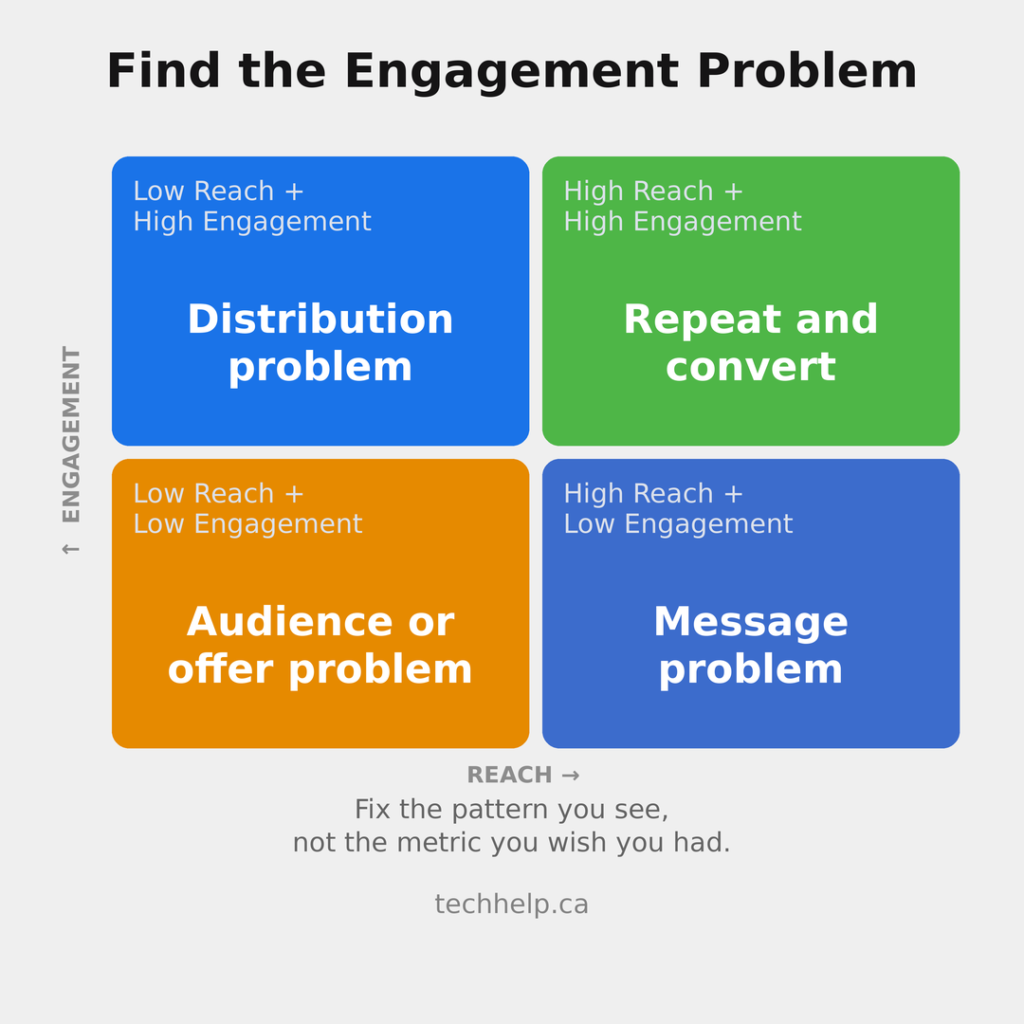
If reach is low but the people who see the post respond, you may have a distribution problem. If reach is high but nobody responds, you may have a message problem. If comments are strong but nobody clicks, books, buys, or messages you, you may have a conversion bridge problem.
How to calculate Facebook engagement rate
There is no single engagement-rate formula that works for every situation. If you are comparing your page against external benchmarks or competitors, engagement rate by followers can be useful because it compares interactions against audience size.
Formula:
Engagement rate by followers = total engagements / followers x 100
If you are judging your own post performance, engagement rate by reach is usually more useful because it shows how many people acted after actually seeing the post.
Formula:
Engagement rate by reach = total engagements / reach x 100
Those two formulas can point to different conclusions. A page with 50,000 followers and weak reach might look bad by follower-based engagement rate, even if the people who saw the post responded well. A post with broad reach might look strong on raw reactions, even if the percentage of people who acted was poor. Use the formula that matches the question you are asking.
If you want to know…
Use this
How your page compares with other pages
Engagement rate by followers
How strong a specific post was with the people who saw it
Engagement rate by reach
Whether a post created business interest
Clicks, messages, leads, bookings, or sales
Whether a topic is worth repeating
Engagement rate plus comment quality
Do not build your Facebook strategy around one metric. Build it around the chain from attention to action.
Why Facebook engagement is harder now
Facebook is still a huge channel. Meta reported 3.60 billion Family daily active people on average for June 2026. DataReportal reported that Facebook’s ad tools showed 198 million users in the United States and 24.6 million users in Canada in late 2025.
Those DataReportal figures are advertising-reach numbers, not active-user or engagement counts. They still show the obvious point: the audience has not disappeared. The harder part is distribution.
Facebook is not a simple chronological feed where every Page post has the same chance to be seen. Meta has explained that Feed ranking uses inventory, signals, predictions, and relevance scoring. Meta’s AI system cards also describe ranking and recommendation systems that use thousands of signals, including post features, previous interactions, and how people engage with similar content or authors.
So when a business page publishes something, Facebook is not only asking, “Did this Page post today?” It is closer to asking questions like these:
Will this person probably care?
Will they watch, click, comment, share, or hide it?
Have they interacted with this Page before?
Do they usually interact with this format?
Are other people responding to it?
Does the post feel worth showing beside everything else competing for attention?
That is why volume alone rarely fixes low engagement. If the post gives Facebook weak signals, posting six versions of the same weak idea only gives the system more weak signals.
Facebook engagement benchmarks for 2026
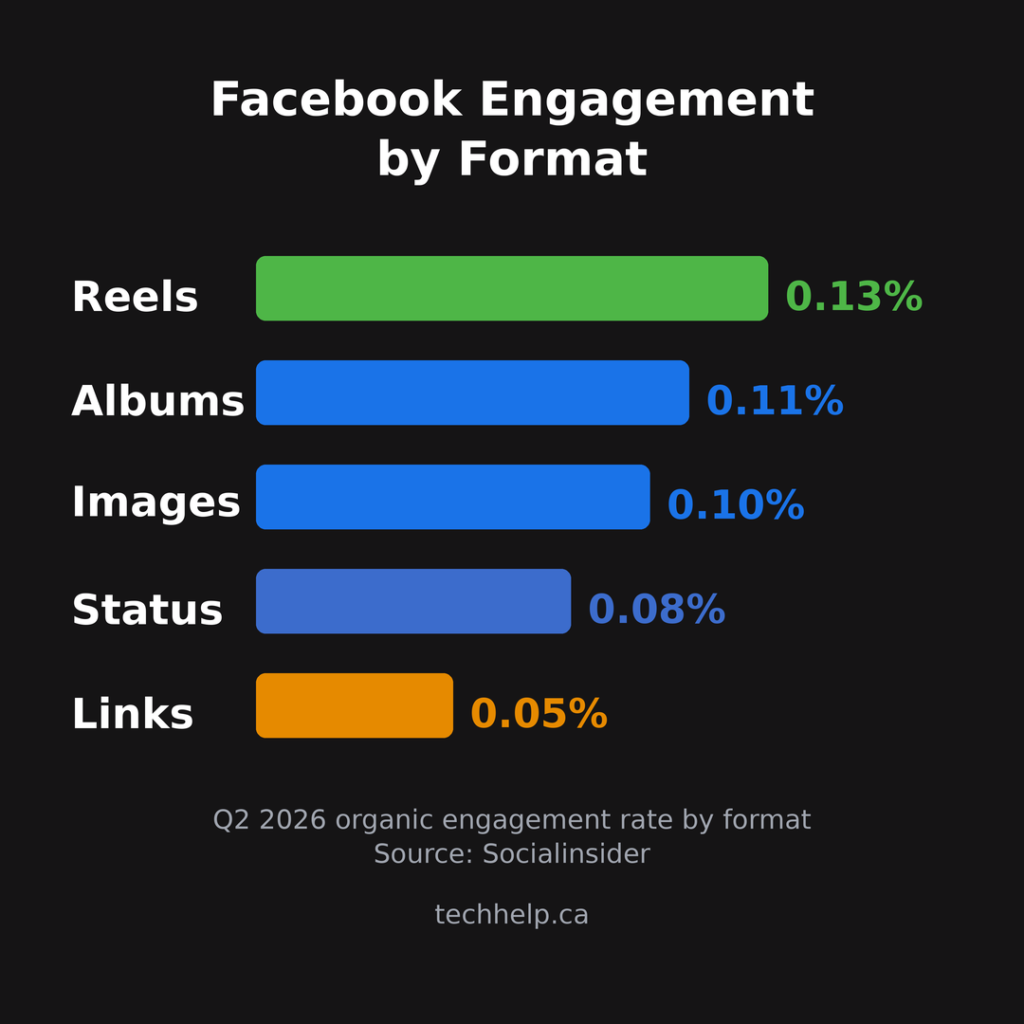
Benchmarks are useful, but only if you use them as context. Socialinsider’s 2026 organic Facebook benchmark report analyzed 25 million posts from more than 130,000 business pages. Its report puts Facebook’s average engagement rate at 0.15%.
It also shows big differences by format and notes that its average engagement-rate calculation uses reactions, comments, and shares divided by fans. That means you should not compare that number directly against a reach-based engagement rate from your own Meta dashboard. Same topic, different denominator.
Here is the useful version of the benchmark picture:
Benchmark
Current figure
How to read it
Facebook average engagement rate
0.15%
A reference point, not a grade
Reels, Q2 2026
0.13%
Strongest format in Socialinsider’s quarterly view
Album posts, Q2 2026
0.11%
Still useful for visual proof and collections
Image posts, Q2 2026
0.10%
Better when the image gives people something to react to
Status posts, Q2 2026
0.08%
Can still create conversation, but performance varies
Link posts, Q2 2026
0.05%
Usually the hardest format for organic engagement
Average brand posting volume
39 posts per month
Fewer than two posts per day on average
The link-post number is especially important for small businesses. If every Facebook post is just “new blog post, click here,” you are asking people to leave the feed before you have earned the click.
That does not mean you should stop sharing links. It means the link needs a stronger reason to exist.
The engagement signals that matter most
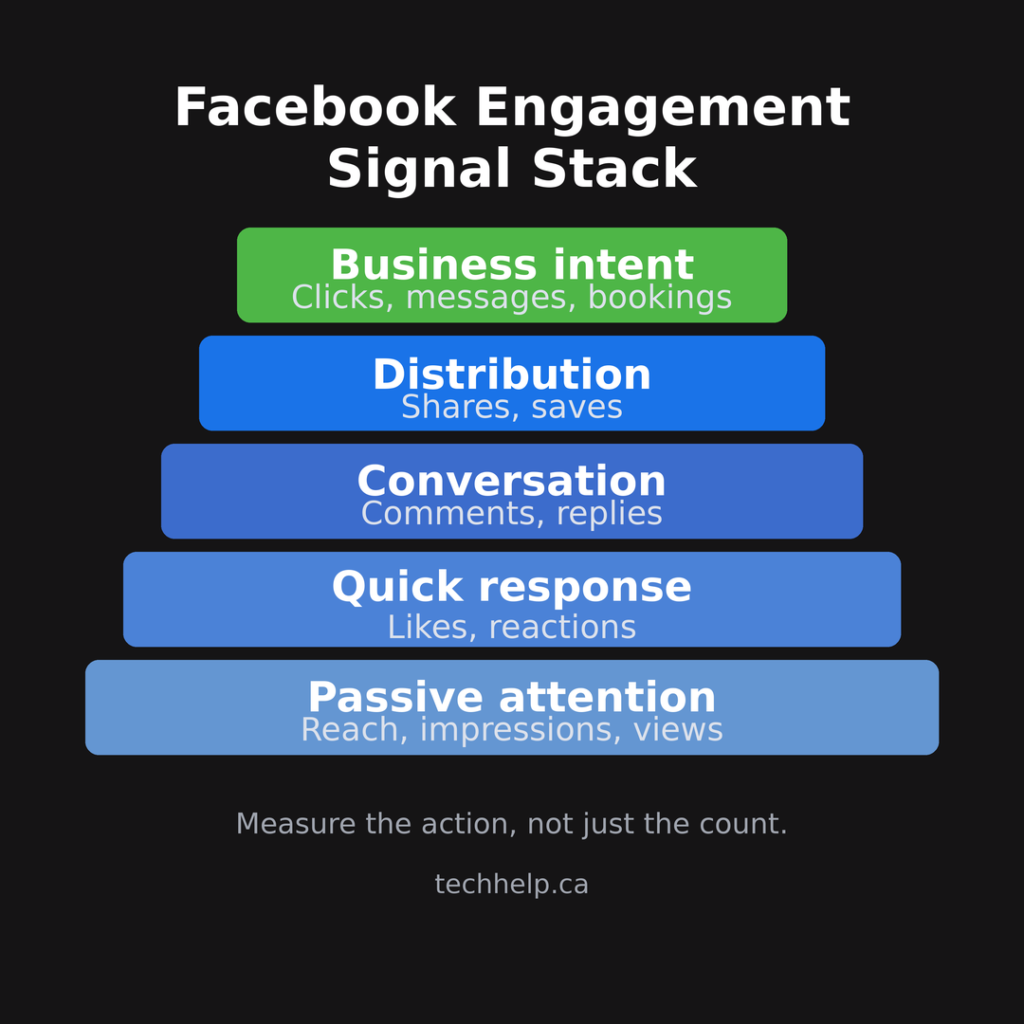
Not every Facebook interaction carries the same business meaning. Think of engagement as a signal stack.
Signal type
Examples
What it usually means
Passive attention
Impressions, views, reach
People had a chance to see it
Quick approval
Likes, reactions
People noticed or agreed
Conversation
Comments, replies
People had something to say
Distribution
Shares, saves, friend interaction
People found it worth passing along or keeping
Business intent
Link clicks, messages, event responses, calls, bookings
People may be ready for the next step
For a business page, the strongest engagement is not always the highest count. A funny post may earn reactions and still produce no customers. A specific post answering one painful buyer question may get fewer reactions but produce comments, DMs, and qualified clicks. You want both attention and intent. If you have to choose, intent is more useful.
How to increase Facebook engagement
Start by changing the question. Do not ask, “What should we post today?” Ask, “What would make the right person stop, care, and respond?” That one shift will improve your Facebook content faster than most posting calendars.
Give each post one job
A weak post tries to teach, sell, entertain, update, start conversation, and drive a click all at once. A stronger post has one job.
Maybe you want people to answer a question. Maybe you want them to click through to a useful article. Maybe you want them to message you. Maybe you want them to share a practical tip with someone else.
Pick the job before you write the post. If you want comments, write a prompt people can answer quickly. If you want clicks, make the payoff clear before the link. If you want messages, make the problem specific enough that the right person recognizes themselves.
Match the format to the behavior you want
Different formats create different behavior. Reels can help with discovery. Albums can work well when you have multiple visuals, examples, steps, or before-and-after proof. Status posts can invite direct responses because they feel low effort. Link posts can drive traffic, but they often need a stronger hook because the user has to leave Facebook.
The mistake is forcing every idea into the same format.
If the idea needs demonstration, use video. If it needs comparison, use an image or carousel-style album. If it needs debate, use a short status post. If it needs depth, use a link post with a reason to click.
Write the first line like it carries the whole post
On Facebook, the first line decides whether the rest of the post gets a chance. That first line should create recognition, curiosity, tension, or immediate usefulness.
Weak opening:
“Check out our latest blog post about email marketing.”
Stronger opening:
“Most small businesses don’t have an email problem. They have a follow-up problem.”
The stronger version gives the reader a reason to keep reading before asking them to click.
You can use the same thinking when writing post captions, article teasers, and promotional updates. If you need help strengthening your hooks, this copywriting hooks guide will give you better starting points than generic “new post is live” copy.
Ask questions people can answer without working
Questions can increase comments, but only when the question is easy to answer and relevant to the audience. “What are your thoughts?” is too vague.
“What is the one marketing task you keep putting off?” is better.
“If you could only fix one thing on your website this month, would you choose speed, copy, design, or SEO?” is even easier because it gives people options.
The goal is not engagement bait. The goal is a useful conversation around something your audience already thinks about.
Turn comments into content
Comments are not only replies. They are research. When someone asks a question, objects, shares a frustration, or adds a useful example, you have a clue. Save it. Reply to it. Use it to create the next post. This is how your page starts to feel less like a broadcast channel and more like a useful presence.
You do not need a massive audience for this to work. If five people keep asking the same question, that question probably deserves a post, a short video, a FAQ, or a deeper article.
Engage as the business, but do it like a person
The old advice to follow and comment on other business pages still has a place, but only when it is done with judgment. Commenting on complementary pages, local business posts, industry discussions, and community conversations can increase visibility, but drive-by comments rarely help.
“Great post!” is invisible. A thoughtful comment that adds a useful angle, answers a question, or shares a practical example can make the right people curious enough to check your Page.
This is also where target audience work matters. If you do not know who you are trying to attract, you will comment in the wrong places and publish posts for the wrong people.
Use current conversations carefully
Current events, industry news, seasonal moments, and platform changes can create engagement because people already care about them. But relevance has to come first.
A dentist does not need to comment on every celebrity scandal. A local restaurant may have a good reason to talk about a major food-cost change. A marketing agency may have a good reason to discuss a Facebook algorithm change.
If the topic naturally connects to your audience’s decisions, use it. If the connection feels forced, skip it.
Treat hashtags as labels, not a strategy
Hashtags are not useless, but they are not a rescue plan for weak Facebook content. Use them when they help categorize a topic, connect to a local event, support a campaign, or make a post easier to understand. Do not stuff a post with hashtags and expect reach to appear. For most business pages, one to three relevant hashtags is enough when hashtags make sense at all.
Build a response rhythm
If people comment and nobody answers, the page feels unattended. Try to reply within the first few hours when possible, especially after publishing. Ask follow-up questions. Thank people when they add something useful. Clarify when someone misunderstands. Move sales-sensitive conversations into messages when needed.
Facebook engagement is not only what people do after you post. It is also what you do after they respond.
Boost posts that already show promise
Paid promotion can help, but it should not be used to hide weak content. If a post is getting strong comments, shares, saves, clicks, or messages from the right audience, a small boost can extend what is already working. If a post has weak organic response and no clear business purpose, boosting it may only buy more silence. Use paid reach to amplify proof, not to avoid learning from the data.
A Facebook engagement diagnostic matrix
Use this matrix when your Page performance drops or stalls.
What you see
Likely problem
Best fix
Low reach, strong engagement rate
Distribution is weak
Repurpose the post, improve early audience targeting, or boost a proven post
High reach, weak engagement
The message is not connecting
Rewrite the hook, tighten the audience, or change the format
Many reactions, few comments
The post is agreeable but not discussable
Ask a more specific question or present a sharper point of view
Many comments, few clicks or messages
Conversation is not connected to the next step
Add a clearer bridge from discussion to action
Link posts keep underperforming
The click is not earned
Make the payoff clearer before the link
Video views start but drop quickly
The opening is too slow
Show the payoff earlier and cut setup
Followers grow but engagement stays flat
The audience may not match the offer
Revisit positioning, content topics, and follower sources
This is where many businesses make the wrong move. They see weak engagement and immediately add more posts. Diagnose the pattern first. Then fix the right part of the system.
A 30-day Facebook engagement reset
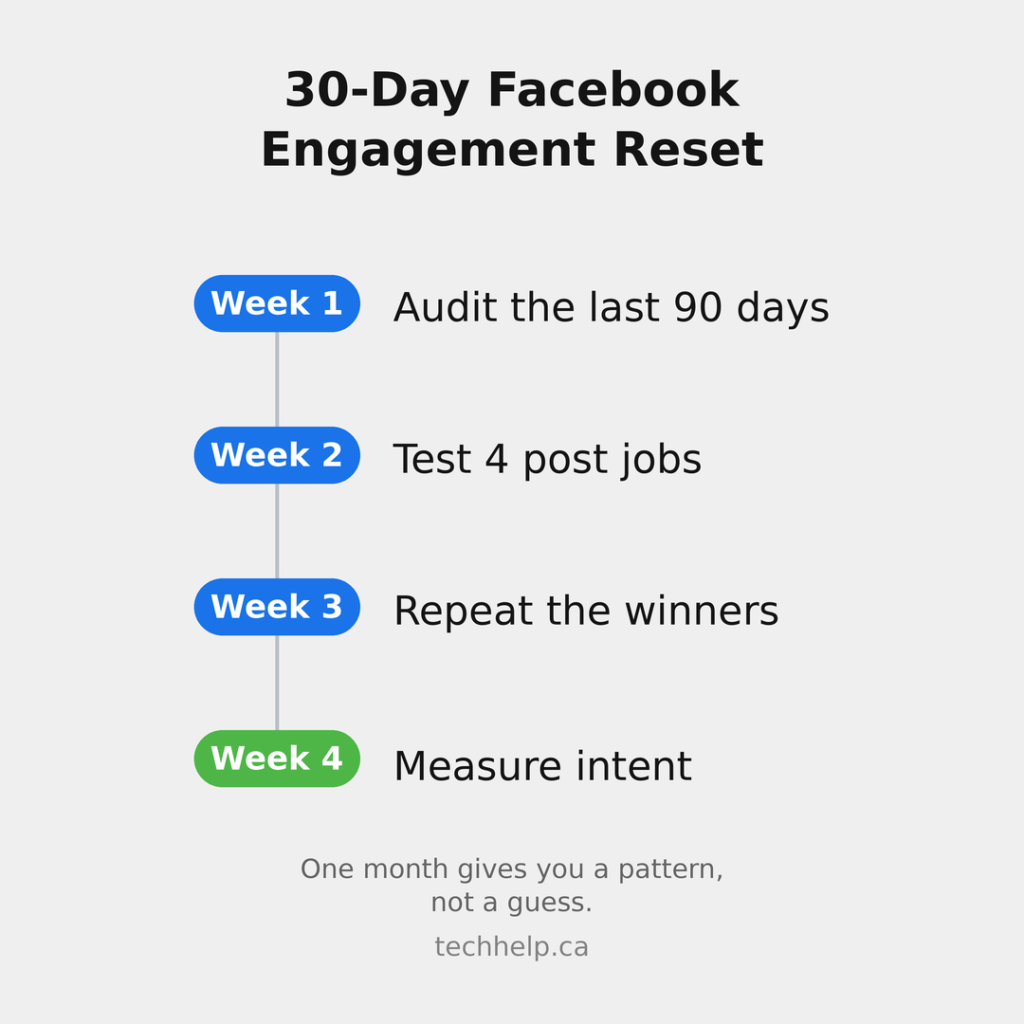
If your Page has gone quiet, give yourself 30 days to find the pattern.
Week
Focus
What to do
Week 1
Audit
Review the last 90 days of posts by reach, engagement rate, comments, shares, clicks, and messages
Week 2
Test
Publish four post types: conversation, teaching, proof, and next-step offer
Week 3
Double down
Repeat the best two formats with new angles and reply faster to comments
Week 4
Measure
Compare reach, engagement quality, clicks, messages, and leads
Do not judge the month by the single biggest post. Judge it by the pattern. Which topics earned comments from the right people? Which formats earned saves or shares? Which posts drove clicks or messages? Which posts got attention but no business value? That is your next month’s plan.
What to stop doing
Some Facebook advice sticks around long after it stops helping:
Stop posting six times a day just to appear active. For many small businesses, that is not consistency. It is noise.
Stop treating every like as a win. Likes are useful, but they are only one layer of engagement.
Stop turning every post into a link dump. If you want the click, earn the click.
Stop chasing every trend. Relevance beats novelty.
Stop asking vague questions. Make it easy for the right person to respond.
Stop ignoring comments after you publish. Engagement is a loop, not a receipt.
If you need the bigger channel plan, start with your social media strategy before you worry about individual post ideas.
The best Facebook engagement strategy is not louder
The best Facebook engagement strategy is clearer. You know who you are trying to reach. You know what action you want from each post. You know which metrics mean attention, which mean conversation, and which mean business interest. Then you use the data to make the next post sharper.
Facebook is still crowded, but crowded does not mean impossible. It means careless posting gets ignored faster.
If your Page is quiet, do not start by shouting more often. Start by giving the right people a better reason to respond.
Frequently Asked Questions
What does engagement mean on Facebook?
Facebook engagement means the actions people take after seeing your content. This can include reactions, comments, shares, saves, clicks, video views, messages, and other interactions depending on the report you are looking at.
What is a good Facebook engagement rate?
A good Facebook engagement rate depends on your industry, audience size, format, and how the rate is calculated. External benchmarks can help, but your own trend line is more useful. If your reach, comments, shares, clicks, messages, or qualified leads are improving, your engagement is moving in the right direction.
How do you calculate Facebook engagement rate?
You can calculate engagement rate by dividing total engagements by followers or by reach, then multiplying by 100. Follower-based engagement is useful for benchmarks. Reach-based engagement is usually better for judging how well a specific post performed with the people who actually saw it.
How often should a business post on Facebook?
Most businesses should post often enough to stay present without flooding their audience. A few useful posts each week can beat several weak posts per day. Start with a consistent schedule, watch engagement quality, and increase frequency only when the content is earning a response.
Do hashtags increase Facebook engagement?
Hashtags can help label a topic, campaign, or local event, but they should not be treated as the main engagement strategy. Strong posts usually win because the topic, hook, format, and audience fit are right. Use hashtags sparingly when they add context.
Why is my Facebook reach high but engagement low?
High reach with low engagement usually means the post was shown to people, but the message did not give them a strong enough reason to act. The fix may be a sharper first line, a more specific question, a stronger visual, a better audience match, or a clearer reason to click or comment.
Are Facebook link posts bad for engagement?
Link posts are not bad, but they often earn lower organic engagement than formats that keep people inside Facebook. If you want people to click, the post has to make the payoff obvious before the link. A vague caption with a URL is usually not enough.
Tech Help Canada Staff researches, writes, and reviews practical content for business owners and professionals. Our coverage spans business, marketing, SEO, technology, and the tools and systems people use to grow and operate online. We focus on clear, useful information backed by research, hands-on experience, and editorial review. Learn more about our team and editorial standards. Need help with something? Contact Us