

Link building strategies for SEO: how to earn backlinks that last
Learn how to earn backlinks without chasing spammy shortcuts. This guide breaks down what makes a link worth having, how to choose the right strategy, how to run outreach, and how to build a backlink profile that supports long-term SEO growth.
What this link building guide covers
Use the table of contents to jump into fundamentals, prospecting, strategy selection, outreach, measurement, or the full strategy library.
Contents
Introduction
Link building is the work of earning links from other websites to your own. Done well, it improves search visibility, referral traffic, brand trust, and discovery across the web. Done badly, it creates risk, wastes money, and leaves a site with a backlink profile that looks manufactured.
The old version of link building was often about volume: directory submissions, exact-match anchor text, mass guest posts, comment links, press release blasts, and quick wins. That version is fragile. Search engines have become better at spotting link spam, and audiences have become better at ignoring generic outreach.
Modern link building is different. It still cares about backlinks, but it starts with value: useful resources, original ideas, credible expertise, relationships, and visibility in places real people already trust.
This resource gives you the full system: how links work, what makes a link worth having, which tactics still work, which ones need caution, how to run outreach, how to measure progress, and what to avoid.
How to use this resource
If you’re new to link building, start with the fundamentals: what links are, what changed, what makes a backlink valuable, and how link attributes work.
If you already know the basics, jump to the operating system: choosing target pages, auditing assets, studying competitors, qualifying prospects, and tracking outcomes.
If you need tactics, use the strategy library by goal or go straight to the full strategy library. The guide covers asset-led link building, outreach, digital PR, partnerships, local links, ecommerce, SaaS, communities, technical reclamation, and risky tactics to avoid.
If you need execution help, use the outreach templates, measurement section, quality checklist, and 30-day plan near the end.
What link building is
Link building is the process of getting other websites to link to pages on your site.
A backlink is an incoming link from another domain. If a relevant industry publication links to your research report, that’s a backlink. If a local chamber of commerce links to your business profile, that’s a backlink. If a journalist quotes your expert commentary and links to your site, that’s a backlink.
Backlinks help search engines discover pages, understand relationships between sites, and evaluate authority. People also click links. A strong link can send qualified referral traffic, introduce your brand to a new audience, and support credibility even before any ranking change appears.
Links aren’t the only part of SEO. Technical SEO, content quality, search intent, internal links, user experience, and brand demand all matter. If you need the broader foundation first, start with what SEO is and how it works.
What changed about link building
The goal is no longer to get as many links as possible.
Google’s spam policies define link spam as creating links to or from a site mainly to manipulate rankings. The policies include examples such as buying or selling links for ranking purposes, excessive link exchanges, large-scale article marketing with keyword-rich anchor text, automated link creation, and low-quality directory or bookmark links.
That doesn’t mean every paid placement, directory, sponsorship, or guest article is unsafe. Intent and disclosure matter. Advertising links, affiliate links, sponsored placements, and user-generated links should use the right rel attributes, such as sponsored, ugc, or nofollow, when appropriate.
The practical shift is simple: build links because your site deserves to be referenced, not because a tactic lets you manufacture authority at scale.
What makes a backlink valuable
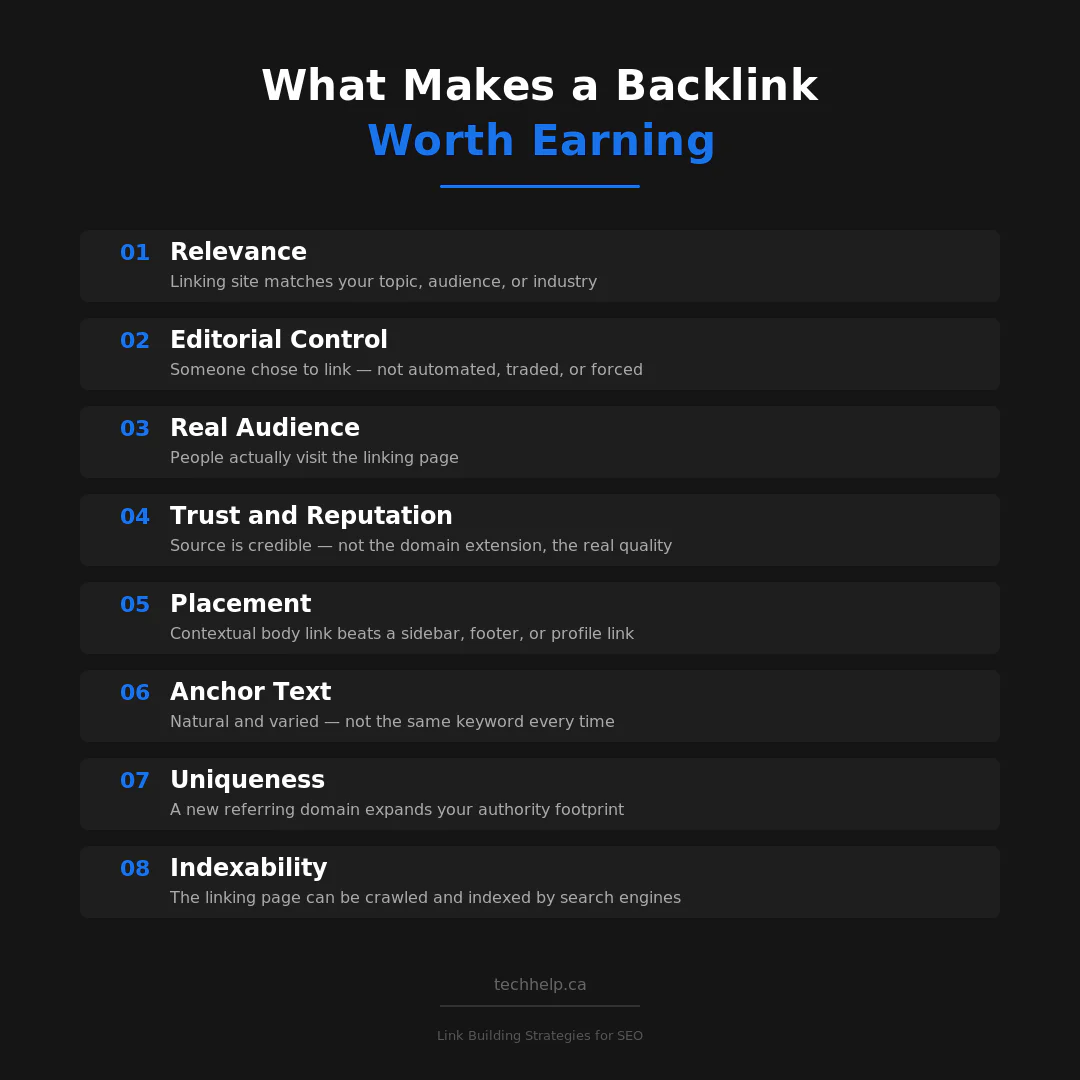
Not every backlink is worth the same effort. A useful link usually has several of these traits.
Relevance
The linking page and site should make sense for your topic. A cybersecurity company getting linked from a security publication is relevant. A cybersecurity company getting linked from a random casino directory isn’t.
Relevance can happen at several levels: the page topic, site topic, author expertise, audience, geography, and search intent.
Editorial control
The strongest links are usually editorial. Someone chose to link because the page helped their audience. A forced, automated, traded, or paid-for-ranking link is weaker and riskier.
Real audience
A link from a page people actually visit is more useful than a link buried on a page nobody sees. Referral traffic isn’t the only goal, but it’s a good reality check. If no human would click the link, ask why it exists.
Trust and reputation
Trusted publications, industry bodies, universities, government pages, respected blogs, and real companies can all be strong link sources. The point isn’t the domain extension alone. A .edu link isn’t magic. A weak, irrelevant page on an education domain can still be weak.
Placement
A contextual link inside the body of a relevant article usually has more value than a footer link, sidebar link, or profile link. Location matters because it affects visibility and context.
Anchor text
Anchor text helps users and search engines understand the linked page. Natural anchor text is varied. If many links use the same exact commercial keyword, the pattern can look manipulative.
Aim for a healthy mix: brand names, page titles, natural phrases, URLs, and occasional descriptive anchors.
Uniqueness
A link from a new relevant domain is often more useful than another link from a site that already links to you many times. That doesn’t mean repeat links are worthless, but new referring domains usually expand your authority footprint.
Indexability and crawlability
If the linking page can’t be indexed or is blocked in a way search engines can’t process, the SEO value may be limited. Still, a nofollowed or blocked link can send referral traffic and brand visibility, so judge it by the goal.
Link attributes: follow, nofollow, sponsored, and UGC
Most normal editorial links don’t need a rel attribute. They are standard links.
Use rel="sponsored" for ads, paid placements, affiliate links, or other compensated links. Use rel="ugc" for user-generated content such as comments or forum posts. Use rel="nofollow" when you don’t want to imply endorsement or when another attribute doesn’t fit.
Google treats these attributes as signals about the nature of a link. They aren’t a license to sell ranking links. They’re a way to keep link relationships transparent.
For link builders, this means a nofollow link isn’t automatically useless. It may still drive traffic, lead to more coverage, expose your brand to journalists, or help people discover your work. But if your only goal is PageRank-style authority, you shouldn’t rely on nofollowed links as your main plan.
The link building system
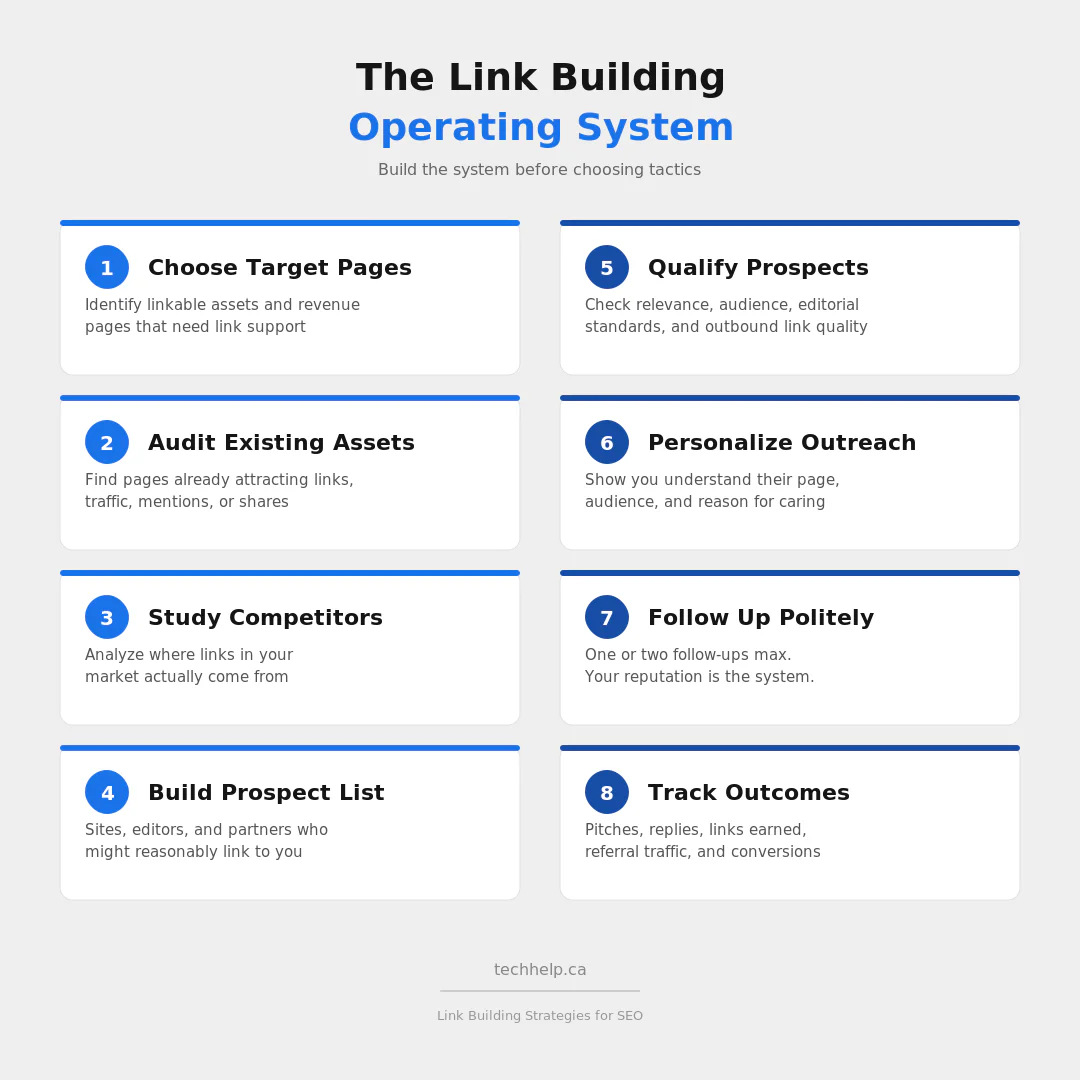
Before choosing tactics, build the operating system. Random link building creates random results.
1. Choose the pages that need links
Some pages are naturally linkable. Others are important for revenue but hard to earn links to.
Linkable pages often include original research, statistics pages, tools, templates, calculators, guides, data visualizations, benchmarks, definitions, and resources. Revenue pages include service pages, product pages, comparison pages, local landing pages, and demo pages.
The usual approach is to earn links to linkable assets, then use internal links to pass relevance and authority to commercial pages.
2. Audit your existing link assets
Look for pages that already attract links, mentions, traffic, or shares. These pages may be easier to improve and promote than starting from zero.
Check which pages have backlinks, which pages rank, which pages answer real customer questions, which pages sales teams use, and which pages competitors already reference.
3. Study competitor backlinks
Competitor backlink analysis shows where links in your market come from.
Look for patterns, not just domains. Are competitors getting links from resource pages, data reports, podcasts, vendor pages, review sites, local organizations, guest articles, tools, or digital PR? Which pages attract the links? Which topics earn attention?
Don’t copy every link. Use the pattern to understand what your market rewards.
4. Build a prospect list
A prospect is a site, page, journalist, editor, organization, or partner that might reasonably link to you.
A good prospect list includes the URL, contact name, email, reason for outreach, target page, relevance notes, authority notes, traffic notes, and status. The reason for outreach matters most. If you can’t explain why your link helps their audience, the prospect is weak.
5. Qualify before you pitch
Before sending an email, check relevance, audience, editorial standards, outbound link quality, recent activity, contact fit, and whether the page already links to similar resources.
Remove obvious spam, expired domains, link farms, low-quality directories, sites selling followed links, and pages that exist only to list hundreds of unrelated links.
6. Personalize outreach
Personalization isn’t using someone’s first name. It means showing that you understand their page, audience, and reason for caring.
The best outreach is specific, short, and useful. It doesn’t beg for a link. It explains the value of the resource and makes the editor’s job easier.
7. Follow up without being annoying
One or two polite follow-ups are enough. If the person doesn’t respond, move on. Your reputation is part of your link building system.
8. Track outcomes
Track sent pitches, replies, links earned, mentions earned, referral visits, assisted conversions, rankings, and links lost. Tie link building to indicators of success so the work stays connected to business results.
Prospecting search operators
Search operators help you find pages that already link out to resources, tools, organizations, experts, and useful content. Treat them as starting points. The real work is qualifying the results.
Resource page queries
Use these when looking for pages built to recommend helpful links:
keyword resourceskeyword useful linkskeyword recommended resourceskeyword helpful resourceskeyword linkskeyword inurl:resourceskeyword intitle:resourceskeyword "recommended reading"keyword "further reading"keyword "useful websites"
Broken link queries
Use these to find pages likely to contain older outbound links:
keyword resourceskeyword "links"keyword "recommended sites"keyword "helpful links"keyword "useful tools"keyword "industry resources"keyword "external resources"
After finding pages, scan them with a browser extension or crawler that detects broken links. Don’t pitch until you know your replacement is relevant to the dead page.
Guest contribution queries
Use these to find legitimate editorial opportunities:
keyword "write for us"keyword "contribute"keyword "guest post"keyword "submission guidelines"keyword "become a contributor"keyword "editorial guidelines"
These queries can also uncover low-quality sites that exist mostly to sell guest posts. Be selective.
Podcast and interview queries
Use these to find shows and interview opportunities:
keyword podcastkeyword "interview with"keyword "guest interview"keyword "podcast guests"keyword "be a guest"keyword "submit a guest"
Check whether the show has a real audience, show notes, episode pages, and topic fit.
List and comparison queries
Use these when looking for inclusion opportunities:
best keyword toolstop keyword companieskeyword alternativeskeyword comparisonkeyword directorykeyword vendorskeyword software listkeyword service providers
These work well for SaaS, ecommerce, professional services, and local businesses.
Local link queries
Use these for city or regional opportunities:
city business directorycity chamber of commerce memberscity local resourcescity event calendarcity small business resourcescity sponsorship opportunitiescity nonprofit partnerscity neighborhood guide
Local link building works best when the business has real local involvement.
Scholarship and education queries
Use these only when you have a real student opportunity:
site:.edu keyword scholarshipsite:.edu keyword internshipsite:.edu keyword career resourcessite:.edu keyword student discountssite:.edu keyword employer partnerssite:.edu keyword alumni business
Don’t chase education links for the extension alone. Relevance and legitimacy matter more.
Prospect qualification scorecard
A prospect list gets weaker when every possible site stays in it. Use a simple scorecard to decide where outreach deserves time.
Score each prospect from 0 to 2 in each category:
- Relevance: Does the site serve your topic, audience, location, or industry?
- Page fit: Does the exact page have a natural place for your link?
- Editorial quality: Does the site publish useful, edited content?
- Audience: Is there evidence real people use the page or site?
- Outbound quality: Does the page link to credible resources, not random spam?
- Relationship reason: Is there a clear reason they should care?
- Risk: Is there any sign of paid link selling, PBN behavior, or irrelevant outbound linking?
High-priority prospects score well on relevance, page fit, editorial quality, and relationship reason. Low-priority prospects may have high domain metrics but no audience fit. Skip them.
Anchor text planning
Anchor text is the clickable text in a link. It helps describe the destination page, but it can become a risk when manipulated.
Natural backlink profiles include many anchor types:
- Brand anchors:
Tech Help Canada - URL anchors:
https://techhelp.ca - Page title anchors:
Link Building Strategies for SEO - Partial-match anchors:
link building strategies - Descriptive anchors:
this guide to earning backlinks - Generic anchors:
read moreorthis resource
You shouldn’t try to control every anchor. If you’re doing legitimate outreach, suggest anchors only when it helps the editor. Avoid repeated exact-match commercial anchors such as best SEO agency Toronto across many sites. That pattern can look manufactured.
For internal links, you have more control. Use descriptive anchors, but keep them natural and varied.
Outreach quality rules
Outreach succeeds when it respects the recipient’s time.
Good outreach is short, specific, relevant, and easy to act on. It explains why the resource helps their audience. It doesn’t pretend to be personal while using a generic pitch. It doesn’t hide the sender’s identity. It doesn’t demand a link.
Before sending a pitch, check five things:
- Is the recipient the right person?
- Did you mention the exact page or context?
- Is the value clear in the first few lines?
- Is the ask simple?
- Would this email still make sense if the recipient never gave you a link?
If the email fails those checks, rewrite it.
Link building tools and what they are for
Tools don’t build links for you. They help you find, qualify, track, and measure opportunities.
Backlink analysis tools
Use tools such as Ahrefs, Semrush, Moz, Majestic, or similar platforms to inspect competitor links, find broken backlinks, monitor lost links, review anchor text, and discover referring domains.
No tool has a complete index of the web. Use more than one source when the campaign matters.
Crawlers
Use crawlers to find broken pages, redirect chains, noindexed pages, internal link gaps, and pages with backlinks that should be preserved.
Search alerts
Set alerts for brand names, founder names, product names, research titles, and unique phrases. Alerts help with unlinked mentions, reputation monitoring, and PR follow-up.
Outreach tools
Outreach tools can manage contacts, templates, follow-ups, and status. Use them carefully. Automation helps with organization, but mass email blasts can damage deliverability and reputation.
CRM or spreadsheet
For many teams, a spreadsheet is enough. Track the prospect, contact, page, angle, target URL, status, date sent, follow-up date, outcome, link URL, anchor, and notes.
Strategy library by goal
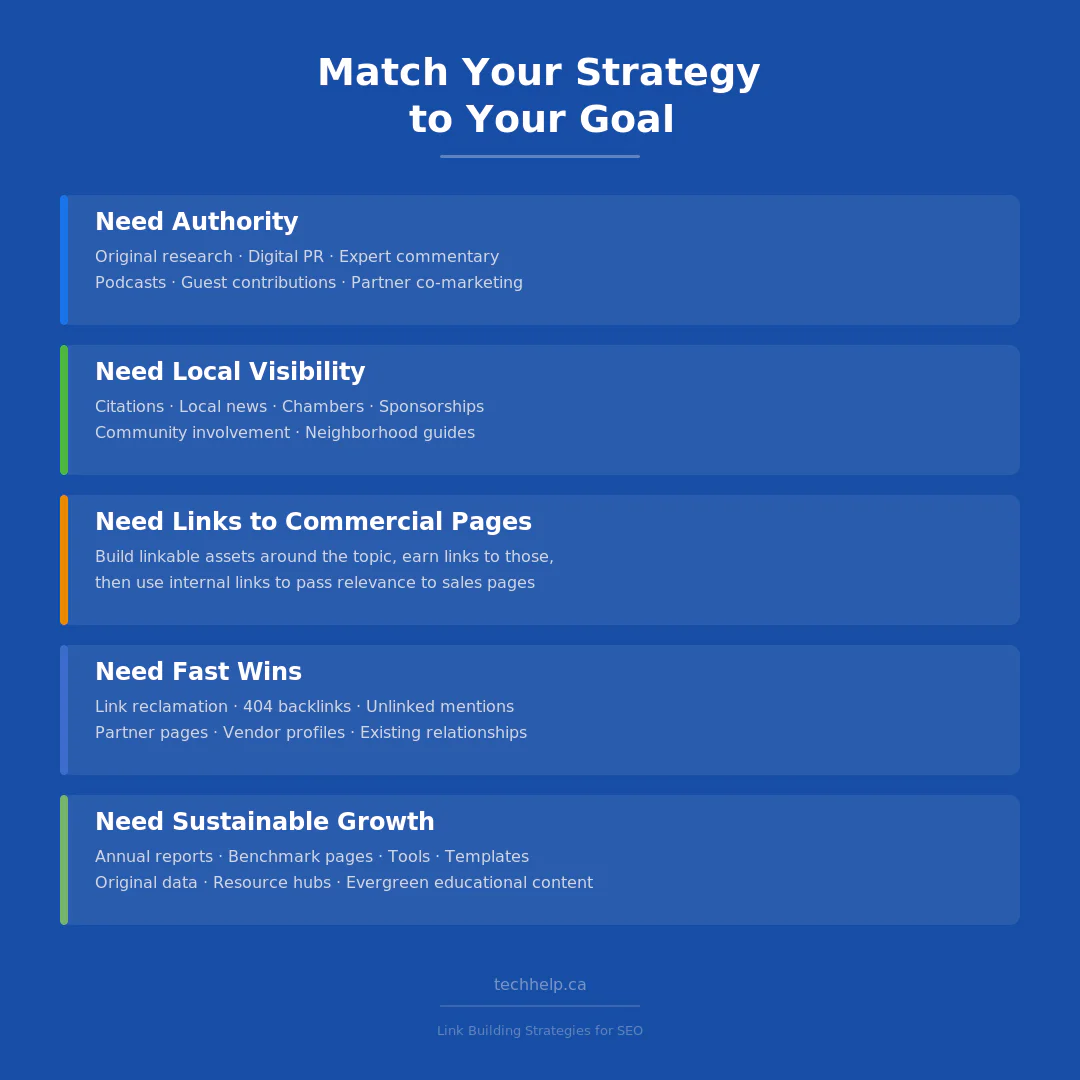
If you’re overwhelmed by the number of tactics, start with the goal.
If you need authority
Prioritize original research, statistics pages, digital PR, expert commentary, podcasts, guest contributions on reputable sites, and partner co-marketing.
If you need local visibility
Prioritize citations, local news, chambers, local associations, community involvement, sponsorships, neighborhood guides, and local testimonials.
If you need links to commercial pages
Direct links to sales pages are harder to earn. Build linkable assets around the topic, earn links to those assets, then add internal links to relevant commercial pages.
If you need fast wins
Start with link reclamation, 404 backlinks, unlinked mentions, partner pages, vendor profiles, testimonials, local profiles, and existing relationships.
If you need sustainable growth
Build recurring assets: annual reports, benchmark pages, tools, templates, original data, resource hubs, and educational content that earns links over time.
Full strategy library
The tactics below are grouped by how they work. You don’t need all of them. Choose the ones that match your industry, resources, credibility, and audience.
Strategy quick index
Linkable asset strategies
These strategies work by creating something worth referencing.
1. Original research
Original research is one of the strongest link earning methods because it gives writers something to cite.
You can run surveys, analyze public data, study customer behavior, review industry pricing, benchmark tools, compare adoption rates, or publish trend reports. The key is to answer a question your industry cares about.
Good research needs a clear method, sample size, limitations, charts, key findings, and a page writers can reference. Make the data easy to quote. Include charts, plain summaries, and downloadable visuals.
Pitch it to journalists, bloggers, newsletter writers, associations, and companies that cover the topic.
2. Statistics pages
A statistics page collects useful data on a focused topic. Writers often search for stats when supporting an article, so a well-maintained stats page can earn links over time.
Don’t scrape random numbers into a thin list. Organize stats by theme, cite original sources, update the page regularly, and add your own analysis. If possible, include original data alongside curated data.
3. Free tools and calculators
Tools earn links because they solve repeatable problems.
Examples include ROI calculators, pricing calculators, template generators, checklist builders, audit tools, benchmark tools, calculators for savings or time, and niche-specific diagnostic tools.
The tool doesn’t need to be complex. A simple calculator that solves a painful problem can attract more links than a long article. The page should explain the use case, show examples, answer common questions, and include embed or sharing options only if they’re useful.
4. Templates and checklists
Templates are easy to reference because they save time.
Create templates for proposals, audits, briefs, SOPs, onboarding, reporting, email outreach, planning, scorecards, or compliance workflows. Pair the download with instructions and examples so it ranks and earns links as a resource, not just a file.
5. Definitive guides
Long guides can earn links when they organize a complex topic better than anything else available.
The guide shouldn’t be long for the sake of length. It should answer the full search intent, include examples, explain decisions, warn against mistakes, and give the reader a working process. If the page becomes the resource people send to beginners, it can earn links naturally.
6. Glossaries and definition hubs
Glossaries work well in technical, legal, finance, health, software, manufacturing, and niche B2B industries.
A good glossary defines terms clearly, links related terms together, and includes real examples. The best ones go beyond dictionary definitions and explain how the term is used in practice.
7. Visual assets
Diagrams, process maps, charts, comparison tables, decision trees, and infographics can attract links when they make a hard concept easier to understand.
Infographics alone aren’t the shortcut they used to be. Many markets are saturated. The visual must be genuinely useful, accurate, and easy to embed or cite. Add supporting text so the page can rank and provide context.
8. Original images and screenshots
If you create original screenshots, diagrams, charts, product photos, or illustrations, track where they appear online.
Use reverse image search or image monitoring tools to find sites using your visuals without credit. Ask for attribution or a link to the original source. Keep the request friendly and factual.
9. Interactive content
Interactive maps, quizzes, scorecards, selectors, comparison tools, and timelines can earn links when they help people explore information quickly.
This works especially well when static content in your market is repetitive. If everyone has the same “how to choose” article, an interactive decision tool can stand out.
10. Case studies
A strong case study can earn links from partners, vendors, customers, industry blogs, and writers looking for proof.
Make the case study specific. Include the starting problem, constraints, actions, results, and lessons. If the customer or partner has a site, ask whether they would share or reference the story.
11. Benchmark reports
Benchmarks help people compare themselves to the market.
Examples include average conversion rates by industry, SaaS onboarding times, local service pricing, average customer response times, marketing spend by company size, or hiring benchmarks. If your data is credible and updated, people will cite it.
12. “Best resources” hubs
A curated resource hub can earn links when it saves people from hunting across the web.
This isn’t a generic list of links. It should include editorial judgment, short notes on why each resource is useful, categories, update dates, and a clear audience.
Content promotion and outreach strategies
These strategies work by finding people who already care about a topic and showing them something useful.
13. Broken link building
Broken link building means finding dead links on relevant pages and suggesting your content as a replacement.
The process is straightforward. Find resource pages, articles, or directories in your niche. Scan for 404 pages. Check what the dead page used to contain. Create or identify a strong replacement. Then contact the site owner with the dead URL, the page where you found it, and your replacement.
The pitch works because you’re helping them fix a problem. Keep it short and precise.
14. Resource page outreach
Resource pages exist to recommend helpful links. If you have a resource that genuinely fits, outreach can work.
Use search operators such as:
keyword resourceskeyword useful linkskeyword recommended toolskeyword inurl:resourceskeyword intitle:resources
Qualify the page before pitching. It should be active, relevant, curated, and not overloaded with unrelated outbound links.
15. Unlinked brand mentions
If a site mentions your brand, founder, product, study, tool, or report without linking, ask whether they can add a link for readers.
This works because the writer already knows you. Your email should be simple: thank them for the mention, point to the page, and explain the link helps readers find the referenced source.
16. Link reclamation
Links get lost when pages move, URLs change, sites redesign, or writers update articles.
Look for links pointing to 404 pages, redirected pages, outdated URLs, or old brand names. Reclaim them by restoring the page, redirecting the URL, or asking the linking site to update the link.
This is often one of the fastest wins because the site already chose to link to you once.
17. Outdated content replacement
Find articles that cite old statistics, closed tools, discontinued platforms, outdated screenshots, or advice that no longer applies.
Create a current replacement, then pitch the writer with the specific outdated reference and your updated source. This works best when the update is meaningful, not cosmetic.
18. Competitor link gap outreach
Find sites that link to multiple competitors but not to you.
These sites have already shown interest in your category. Your job is to figure out why they link to competitors and whether you have something that fits the same page. The best targets are lists, comparisons, resource hubs, associations, tools pages, review pages, and articles that cite several solutions.
19. The “moving business” method
Look for businesses, tools, products, or resources in your niche that have shut down, rebranded, moved, or been acquired.
If many pages still link to the old resource, create a useful replacement or migration guide. Then contact the sites linking to the outdated resource and suggest the current alternative.
This is a cousin of broken link building, but it also works for pages that still load yet no longer serve the same purpose.
20. Email people you mention
If you quote, cite, or include someone in your content, let them know.
Don’t ask for a link in the first sentence. Send the page, mention what you included, and explain why their work was useful. Some people will share it, some will link later, and some will become future collaborators.
21. Expert roundups
Expert roundups can still work when they’re selective and insightful.
Avoid generic posts where 80 people answer the same shallow question. Instead, ask a narrow question, invite credible people, edit the answers into a useful article, and add analysis. Contributors may share or link to the finished piece because it reflects well on them.
22. Guest contributions
Guest posting isn’t dead, but low-quality guest posting is overused.
Write for sites that have a real audience, editorial standards, and topical relevance. Contribute something useful that the site would publish even without a link. Avoid exact-match anchor text, spun content, mass outreach, and sites that accept anything.
The main benefits are visibility, relationships, referral traffic, and authority. The link is part of the value, not the whole reason to contribute.
23. Podcast guesting
Podcasts create links through show notes, guest pages, episode summaries, and related articles.
Pitch shows where your expertise matches the audience. Offer a clear angle, not a biography. After the episode goes live, share it, link to it, and repurpose the conversation into your own content.
24. Interviews
Interviews can earn links from publications, blogs, newsletters, podcasts, YouTube channels, associations, and community sites.
You can pitch yourself as a subject-matter expert, but the strongest angle is usually tied to a timely topic, original data, unusual experience, or a lesson the audience can use.
25. Link roundups and newsletter inclusion
Some blogs and newsletters regularly curate useful links.
Find them by searching your topic plus terms like weekly roundup, best links, reading list, newsletter, or recommended reads. Pitch only your strongest pieces. Roundup editors see a lot of mediocre submissions, so relevance matters.
26. Blogger and creator outreach
Creators often influence niche audiences that larger publications ignore.
Build relationships before asking for anything. Comment thoughtfully, share useful work, respond to their questions, and understand their audience. When you pitch, make it about their readers, not your backlink goal.
27. Content refresh outreach
Find pages that already link to resources similar to yours. If your resource is more current, deeper, or easier to use, pitch it as an update.
This works well when your page includes newer data, better examples, a tool, a downloadable template, or clearer visuals.
28. Skyscraper-style content
The skyscraper approach means finding a page that has earned many links, creating something meaningfully better, then promoting it to people who linked to the original.
The danger is creating a longer copycat page. Better means more useful, more current, more complete, easier to use, more visual, more credible, or more original. Length alone isn’t a strategy.
Digital PR strategies
These strategies earn links by giving media, writers, and communities something worth covering.
29. Journalist source requests
Journalist-source platforms connect reporters with experts. HARO was long the best-known option, later operated under Cision’s Connectively brand, and that service was discontinued in December 2024. In April 2025, Cision announced the sale of HARO to Featured.com.
The category still matters. Options may include HARO under its new ownership, Featured.com, Qwoted, SourceBottle, ProfNet-style services, niche journalist lists, and direct media outreach.
The rule is quality over speed. Answer only queries where you have real expertise. Lead with credentials, respond directly, keep it quotable, and never turn the pitch into a product ad.
30. Data-led PR
Data-led PR turns research into media angles.
Examples include “cities with the highest remote-work growth,” “industries with the fastest response times,” “average cost of X by state,” or “consumer attitudes toward Y.” Journalists like data when it’s timely, surprising, localizable, and easy to explain.
Build a media list before publishing. Give writers the headline, the method, the strongest findings, and ready-to-use visuals.
31. Reactive PR
Reactive PR means responding quickly to news with expert commentary.
When an industry story breaks, journalists need context. If you can provide a credible quote, explanation, or data point fast, you may earn mentions and links.
Prepare by creating expert bios, media pages, headshots, credentials, and topic areas ahead of time. Speed matters, but accuracy matters more.
32. Newsworthy announcements
Press releases can still support visibility, but only when the story is actually newsworthy.
Newsworthy angles include original research, major partnerships, product launches with a real market change, funding, acquisitions, events, awards, leadership changes, community impact, or public-interest data.
Don’t use press releases as a link scheme. Many distribution links are nofollowed or syndicated in ways that provide little SEO value. The real goal is coverage from journalists and relevant publications.
33. Opinion pieces and bylines
A strong opinion piece can earn links and brand mentions when the argument is timely and well supported.
Pitch editors with a clear thesis, why their audience should care, and why you’re qualified to write it. Avoid generic thought leadership. Editors want a point of view, not a sales brochure.
34. Awards and rankings
Awards and rankings can earn links if they’re credible, transparent, and useful.
You can apply for industry awards, submit to legitimate rankings, or create your own ranking using a clear method. If you create one, publish the criteria and avoid pay-to-play optics.
35. Events and conferences
Events create many link opportunities: speaker pages, sponsor pages, resource pages, recap posts, slides, recordings, local calendars, association newsletters, and partner announcements.
If you host, speak, sponsor, or publish a resource for attendees, make sure there is a clear page others can link to.
Partnership and relationship strategies
These strategies work because business relationships naturally create reasons to link.
36. Vendor and supplier links
If you’re a vendor, supplier, reseller, installer, certified partner, or implementation partner, check whether the company has a partner directory.
These links are relevant and often useful for customers. Make sure your profile is complete, accurate, and helpful.
37. Customer and client case study links
When you publish a case study with a client, ask whether they will share it from their site or newsroom.
Don’t pressure them. Frame it as a shared success story and give them copy, images, and a clear URL.
38. Testimonials
Companies often publish customer testimonials and case studies with links to the customer’s site.
If you genuinely use a tool, service, vendor, or partner, offer a useful testimonial. This should be honest and specific. Don’t fabricate relationships for links.
39. Integration and app directories
SaaS companies, ecommerce tools, CRMs, marketplaces, and plugin ecosystems often have integration directories.
If your product integrates with another platform, create a dedicated integration page and request inclusion. These links can send qualified traffic and support product discovery.
40. Associations and memberships
Industry associations, local business groups, trade organizations, and chambers of commerce often maintain member directories.
Join because the organization is relevant, not because you want any link you can get. A local chamber link, for example, can support local trust and referral traffic.
41. Alumni pages
Many schools, bootcamps, and programs feature alumni businesses, alumni stories, employer partners, or career outcomes.
If you have a legitimate connection, ask whether they maintain a profile page or business directory. Keep the request tied to the relationship.
42. Job and internship pages
If you offer internships, apprenticeships, co-op roles, or entry-level jobs, universities and training programs may list the opportunity.
This can earn relevant links and attract candidates. The opportunity must be real. Creating fake internships for links is a bad idea.
43. Sponsorships
Local events, charities, podcasts, newsletters, conferences, clubs, and community projects often link to sponsors.
Sponsorship links may need sponsored or nofollow attributes depending on the arrangement. Treat the link as a visibility benefit, not the only reason for sponsoring.
44. Scholarships and education resources
Scholarships used to be heavily abused for .edu links. They can still be legitimate when the scholarship is real, relevant, funded, and useful to students.
A better approach is often an education resource, internship program, apprenticeship, research collaboration, or career guide that genuinely helps a school audience.
45. Partner resource swaps
Some businesses create resource pages for trusted partners, vendors, tools, or referral options.
This can be legitimate when the recommendations are real and useful. Avoid excessive reciprocal linking or link exchange schemes where the main purpose is ranking manipulation.
Local link building strategies
Local link building is about becoming visible in the real community you serve.
46. Local citations
Local citations are mentions of your business name, address, phone number, and website on directories or local platforms.
Focus on accurate listings on real platforms: Google Business Profile, Bing Places, Apple Business Connect, Yelp, industry directories, local chamber pages, municipal business directories, and niche local sites.
The goal is consistency and trust, not hundreds of weak listings.
47. Local news
Local reporters cover business openings, expansions, hiring, events, community programs, data, and local impact.
Pitch stories that matter locally. A generic announcement is weak. A story about jobs, community benefits, local data, or a useful public resource is stronger.
48. Local guides
Create useful local resources that people in your area would reference.
Examples include neighborhood guides, event calendars, relocation guides, local cost calculators, maps, seasonal checklists, or “best resources for small businesses in [city]” pages.
If the guide is actually useful, local organizations, bloggers, schools, realtors, and community groups may link to it.
49. Community involvement
Volunteer work, workshops, mentorship, free clinics, local sponsorships, and community education can all lead to natural links.
Do the work first. The link is documentation of real participation.
50. Local testimonials and partnerships
Leave real testimonials for local vendors, venues, nonprofits, consultants, and partners you work with.
Local businesses often publish testimonials with links because they support trust and show community relationships.
Ecommerce link building strategies
Ecommerce sites often struggle because product pages aren’t naturally linkable. The key is to create assets around products, not only product pages.
51. Product education guides
Create buying guides, care guides, sizing guides, material comparisons, safety guides, installation tutorials, or troubleshooting pages.
These earn links more easily than product pages because they help people make decisions.
52. Product data and tests
Test products, compare durability, measure performance, or publish transparent benchmarks.
Original product testing can earn links from reviewers, journalists, forums, and buyers because it provides evidence.
53. Coupon and discount pages
Coupons can attract links from deal pages, student discount pages, military discount pages, and partner lists.
Use caution. Discount pages should serve real customers. Don’t submit to low-quality coupon farms or create fake discounts for links.
54. Gift guides
Gift guide outreach can work when the product fits a specific audience and season.
Pitch early, personalize the angle, and provide product photos, pricing, availability, and why it fits the guide. Some placements may be affiliate or sponsored, so link attributes may apply.
55. Review outreach
Product reviews can send traffic and build credibility.
If you provide free products or compensation, disclosure matters and links should be qualified properly. Focus on honest reviews from creators whose audience matches your product.
56. Marketplace and retailer profiles
If you sell through marketplaces, distributors, app stores, or retail partners, complete your profiles and link back where allowed.
These links may not always pass SEO value, but they help discovery and trust.
SaaS and B2B link building strategies
B2B links often come from authority, education, partnerships, and use-case content.
57. Comparison and alternative pages
Comparison pages can earn links when they’re fair, detailed, and useful.
Don’t create thin “us vs. them” pages that only praise your product. Include real criteria, tradeoffs, feature differences, pricing context, integrations, and use cases.
58. Integration guides
If your software connects with other tools, create integration guides and ask partners to list them.
These pages help users and create natural links from partner ecosystems.
59. Templates for your audience
B2B audiences often search for templates: RFPs, scorecards, implementation plans, migration checklists, audit worksheets, reporting dashboards, and SOPs.
Templates can earn links from blogs, consultants, newsletters, and communities because they save time.
60. Industry benchmarks
Use product data, customer surveys, anonymized usage data, or public datasets to publish benchmarks.
Examples include average time to deploy, adoption rates by industry, conversion benchmarks, response time data, or cost savings by company size.
61. Partner co-marketing
Co-host webinars, reports, guides, events, and research with partners.
Each partner promotes the asset, and both sides may earn links from audiences that already overlap.
62. Certification and training pages
If you offer training, certification, or implementation education, create pages that partners, students, employers, and industry groups can reference.
Make the credential meaningful. Weak certificates created only for links won’t build trust.
Community and social strategies
Community links are often nofollowed or user-generated, but they can still drive awareness, referral traffic, and secondary links.
63. Forum participation
Forums still work when you behave like a real member.
Choose active communities in your niche. Answer questions, share experience, and build credibility. Link to your own content only when it directly helps the discussion. A profile link isn’t the main benefit. The relationship and referral traffic are.
64. Reddit participation
Reddit can send attention, but it punishes self-promotion quickly.
Use Reddit for research first. Learn the language, pain points, common objections, and repeated questions. If you share a link, make sure it answers the thread better than anything else and be transparent about your relationship to it.
65. LinkedIn and social distribution
Social links may not behave like editorial backlinks, but social distribution helps content reach people who can link.
Share strong assets with a useful summary. Tag contributors when appropriate. Repurpose data into carousels, short posts, threads, and videos. The goal is to get the asset in front of people who write, curate, and reference.
66. Niche newsletters
Newsletters are powerful link and mention sources because they reach focused audiences.
Find newsletters in your market, study what they include, and pitch resources that fit their format. A newsletter mention may lead to direct traffic, later editorial links, and new relationships.
67. Slack, Discord, and private communities
Private communities can help you build relationships and discover link opportunities.
Don’t join only to drop links. Contribute first. Share useful resources when the topic comes up naturally.
68. Wikipedia and community knowledge bases
Wikipedia shouldn’t be used as a link building shortcut.
If you have a genuinely reliable, neutral source that supports a factual claim, it may be appropriate to suggest or add it under the site’s rules. Promotional pages, commercial sources, and self-serving edits can damage reputation.
The same principle applies to community wikis, GitHub lists, and knowledge bases: contribute value, follow rules, and avoid self-promotion.
Technical and reclamation strategies
These tactics recover value you already earned or make link acquisition easier.
69. Fix 404 pages with backlinks
Use Google Search Console or backlink tools to find broken URLs on your site that have incoming links.
Restore the page if it should exist. If not, redirect it to the closest relevant page. Avoid redirecting everything to the homepage.
70. Consolidate duplicate assets
If several pages cover the same topic and attract separate links, consider consolidating them into one stronger page.
Use redirects carefully, update internal links, and make the final page better than the old versions.
71. Build internal links from linkable assets
A linkable asset can earn external links, but your commercial pages still need support.
Use internal links from research, tools, guides, and resource pages to relevant service or product pages. Keep anchor text natural and useful.
72. Monitor lost links
Links disappear when pages are updated, deleted, redesigned, or moved.
Monitor lost links. If an important link disappears, check why. If the page still exists and your resource is still relevant, a polite request may restore it.
73. Track brand and product mentions
Set alerts for your brand, product names, founder names, report titles, and unique phrases from your content.
When someone references you without a link, decide whether a link request is appropriate. Sometimes a mention is enough. Sometimes a source link genuinely helps readers.
74. Protect original assets
If people copy your tools, images, charts, or research without attribution, document it.
Start with a friendly attribution request. If the use is harmful or unauthorized, consider a takedown path. Many cases can be solved without legal pressure.
Editorial fees
Some legitimate websites charge an editorial fee when they review outside contributions. That fee usually covers the publisher’s time: reviewing the pitch, checking the article, editing, formatting, uploading, and deciding whether the piece meets their standards.
That isn’t the same thing as buying a link.
A good publisher can still reject weak content after charging a review or editorial fee. They’re not selling guaranteed approval. They’re charging for the work involved in handling the submission.
The risk starts when the fee becomes a disguised link purchase. If the arrangement guarantees a followed backlink, allows keyword-stuffed anchor text, accepts thin content, or exists mainly to pass ranking value, treat it as risky. In those cases, the link may need to be qualified with sponsored or nofollow, depending on the arrangement.
For link builders, the safer approach is simple: judge the site by its audience, standards, relevance, and editorial control. If the fee only buys review time and the publisher can say no, that’s a good sign you’re in the right place. If the site accepts anything as long as payment clears, that’s a sign you may be dealing with the wrong publisher.
Tactics that need caution
Some tactics can be legitimate in the right context but risky when used mainly for ranking.
Directories
Directories are useful when they have real users, editorial standards, and relevance. They are weak or risky when they accept every site, exist only for links, or list unrelated businesses.
Good directory examples may include industry associations, local chambers, software marketplaces, professional bodies, vendor directories, and trusted niche directories.
Press release distribution
Press releases are useful for communication. They aren’t a magic backlink machine.
Use press releases for newsworthy stories and media discovery. Don’t expect syndicated press release links to carry much SEO value by themselves.
Donations and sponsorships
Donations and sponsorships can create visibility and goodwill. If the link is part of a paid arrangement, qualify it properly.
Don’t donate only to get a followed link. Google has long treated links exchanged for money, goods, or services as a link spam risk when used to manipulate rankings.
Reciprocal links
Normal business relationships often create reciprocal links. That’s fine when it helps users.
The risk appears with excessive link exchanges, partner pages full of unrelated sites, or “you link to me and I will link to you” campaigns built only for ranking.
Guest posting
Guest posting is useful for audience building and expertise. It becomes risky when scaled with thin content, keyword-rich anchors, irrelevant sites, or paid placements without disclosure.
Scholarships
Scholarship link building became overused because many SEOs chased .edu links. If you run a real scholarship, publish it and promote it honestly. If the scholarship exists only to get links, skip it.
AI-generated outreach
AI can help organize research, summarize prospects, or draft a first pass. It shouldn’t mass-send generic pitches.
Editors can spot lazy outreach quickly. Use AI for support, then personalize with real judgment.
Tactics to avoid
Avoid anything that creates links mainly to manipulate rankings rather than help users.
That includes private blog networks, link farms, automated link drops, mass comment spam, forum profile spam, hidden links, hacked links, doorway pages, excessive exact-match anchors, low-quality article directories, bulk paid guest posts, irrelevant sitewide footer links, and paid links that aren’t qualified properly.
Also avoid “toxic backlink panic.” Not every weird backlink is a crisis. Google’s disavow guidance says to use the tool only when you have a considerable number of spammy, artificial, or low-quality links and those links have caused, or are likely to cause, a manual action. Use disavow carefully, especially when you have a manual action or a clear history of manipulative link building.
Outreach templates
Templates are starting points, not scripts to blast.
Broken link outreach
Subject: Broken link on [Page Name]

Hi [Name],

I was reading your page on [topic] and noticed that one of the links no longer works:

[Broken URL]

The section is still useful, so I thought you would want to know. We have a current resource on the same topic here:

[Your URL]

No pressure to use it, but it may be a helpful replacement for readers.

Thanks,
[Name]
Resource page outreach
Subject: Resource suggestion for [Page Topic]

Hi [Name],

I found your [page name] while researching [topic]. The section on [specific section] is especially useful.

We recently published [resource name], which helps [audience] with [specific problem]. It includes [data/tool/template/example], so it may fit your resource list:

[URL]

Either way, thanks for maintaining the page.

[Name]
Unlinked mention outreach
Subject: Thanks for mentioning [Brand]

Hi [Name],

Thanks for mentioning [Brand] in your article on [topic]. I appreciate it.

Would you consider linking the mention to [URL]? It would help readers find the source you referenced.

Thanks again,
[Name]
Journalist pitch
Subject: Source for [Query Topic]

Hi [Name],

I can help with this. I am [one-line credential], and I work with [relevant audience/problem].

My short answer:

[2-4 concise, quotable sentences that directly answer the query]

You can verify my background here: [bio/press page]

Happy to clarify if useful.

[Name]
Guest contribution pitch
Subject: Article idea for [Site Name]

Hi [Name],

I enjoyed your recent piece on [specific article]. It made me think your readers may also find this angle useful:

[Proposed headline]

The article would cover:

- [Point 1]
- [Point 2]
- [Point 3]

I would keep it practical, original, and written for [site audience]. A short bio is here if helpful: [URL]

Thanks,
[Name]
How to measure link building
A link campaign should be measured by more than backlink count.
Track referring domains, relevance, link quality, link placement, anchor distribution, links to priority pages, referral traffic, assisted conversions, rankings for target topics, branded search, journalist relationships, mentions, and links lost.
For each campaign, define the goal before outreach begins. A digital PR campaign may prioritize media coverage and brand mentions. A broken link campaign may prioritize links to one resource. A local campaign may prioritize trust and referral traffic. A SaaS integration campaign may prioritize qualified product discovery.
Use an action plan so the campaign has owners, deadlines, target pages, prospect criteria, and follow-up rules.
How to choose the right strategy
The right tactic depends on the site.
New sites usually need credibility, relationships, and a few linkable assets. Start with local links, partner links, business profiles, resource pages, testimonials, and one strong content asset.
Established sites should look for link reclamation, competitor gaps, original research, digital PR, and scalable assets such as tools or benchmark reports.
Local businesses should focus on citations, local media, chambers, community pages, sponsorships, local guides, testimonials, and partnerships.
Ecommerce sites should create buying guides, product tests, gift guide pitches, creator reviews, discount pages, and useful category resources.
B2B and SaaS companies should prioritize integrations, templates, data reports, expert commentary, partner pages, podcasts, comparison resources, and customer case studies.
Content-heavy sites should build statistics pages, original research, expert roundups, visual assets, and resource hubs.
A 30-day link building plan
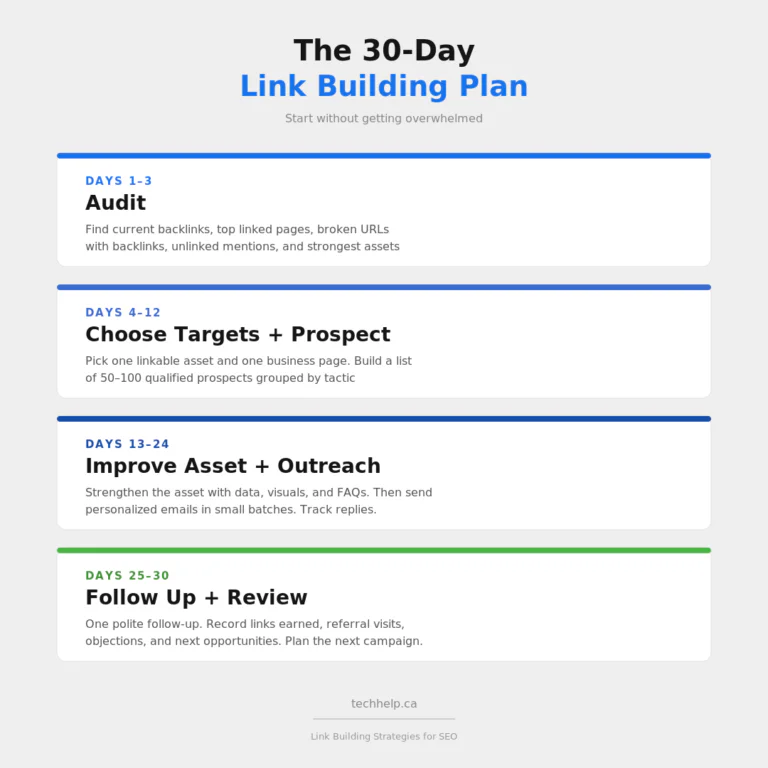
Use this plan to start without getting overwhelmed.
Days 1-3: audit
Find your current backlinks, top linked pages, broken URLs with backlinks, unlinked brand mentions, and strongest content assets.
Days 4-7: choose targets
Choose one linkable asset to promote and one business page that needs support. Add internal links between them where relevant.
Days 8-12: prospect
Build a list of 50 to 100 qualified prospects. Group them by tactic: resource pages, broken links, unlinked mentions, journalist opportunities, partners, local organizations, or competitor gaps.
Days 13-17: improve the asset
Before outreach, make the asset stronger. Add examples, data, visuals, FAQs, citations, templates, or a clearer structure.
Days 18-24: outreach
Send personalized emails in small batches. Track replies. Improve your pitch based on what people respond to.
Days 25-27: follow up
Send one polite follow-up to non-responders. Don’t push. If the fit is weak, move on.
Days 28-30: review
Record links earned, replies, objections, referral visits, and next opportunities. Update your prospect list and plan the next campaign.
Link building quality checklist
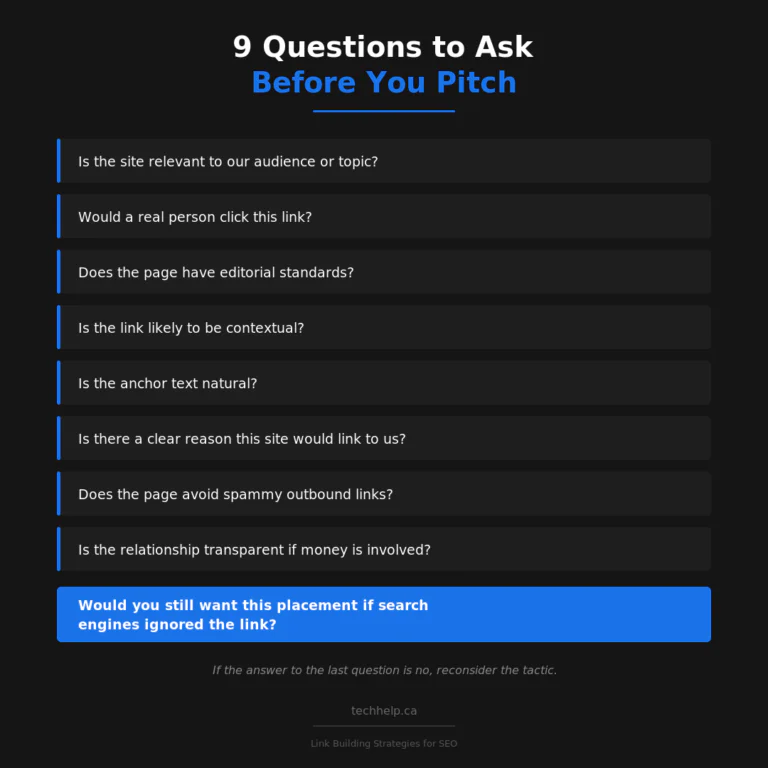
Before pursuing a link, ask:
- Is the site relevant to our audience or topic?
- Would a real person click this link?
- Does the page have editorial standards?
- Is the link likely to be contextual?
- Is the anchor text natural?
- Is there a clear reason this site would link to us?
- Does the page avoid spammy outbound links?
- Is the relationship transparent if money, products, or sponsorship are involved?
- Would we still want the placement if search engines ignored the link?
If the answer to the last question is no, reconsider the tactic.
Final takeaway
Link building isn’t a shortcut around good marketing. It’s good marketing made visible through links.
The safest, strongest links come from real value: useful assets, original research, helpful tools, credible expertise, strong relationships, community involvement, and smart promotion. The weakest links come from shortcuts that exist only to manipulate rankings.
Build things worth referencing. Put them in front of the right people. Track what works. Improve the asset. Repeat.
That’s how link building becomes a compounding asset instead of a risky chore.
References
https://developers.google.com/search/docs/essentials/spam-policies
https://developers.google.com/search/docs/crawling-indexing/qualify-outbound-links
https://developers.google.com/search/blog/2021/07/link-tagging-and-link-spam-update
https://support.google.com/webmasters/answer/2648487
https://backlinko.com/link-building-strategies
https://backlinko.com/link-building
https://ahrefs.com/seo/link-building
https://www.semrush.com/blog/link-building/
https://www.cision.com/connectively-has-been-discontinued/
https://www.cision.com/about/press-releases/2025-press-releases/cision-announces-sale-of-help-a-reporter-out-haro-to-featuredcom-302427990/
